Real change happens when a platform evolves in ways that remove old constraints, open new economic paths, and give IT teams strategic room to maneuver. Nutanix has introduced enhancements that, taken individually, appear to be technical refinements, but observed together, they represent something more profound. The transition of the Nutanix Cloud Platform (NCP) into a fabric of compute, storage, and mobility that behaves as one system, no matter where it runs.
This is the dismantling of long-standing architectural trade-offs and the business impact is far greater than the technical headlines suggest.
In this article, I want to explore four developments that signal this shift:
- Elastic VM Storage across Nutanix clusters
- Disaggregated compute and storage scaling
- NC2 is generally available on Google Cloud
- The strategic partnership between Nutanix and Pure Storage
Individually, these solve real operational challenges. Combined, they create an infrastructure model that moves away from fix constructs and toward an adaptable, cost-efficient, cloud-operating fabric.
Elastic VM Storage – The End of Cluster-Bound Thinking
Nutanix introduced Elastic VM Storage, which the ability for one AHV cluster to consume storage from another Nutanix HCI cluster within the same Prism Central domain. It breaks one of the oldest implicit assumptions in on-premises virtualization that compute and storage must live together in tightly coupled units.
By allowing VMs to be deployed on compute in one cluster while consuming storage from another, Nutanix gives IT teams a new level of elasticity and resource distribution.
It introduces an operational freedom that enterprises have never truly had:
- Capacity can be added where it is cheapest. If storage economics favour one site and compute expansion is easier or cheaper in another, Nutanix allows you to make decisions based on cost, not on architectural constraints.
- It reduces stranded resources. Every traditional environment suffers from imbalanced clusters. Some run out of storage, others out of CPU, and upgrading often means over-investing on both sides. Elastic VM Storage dissolves those silos.
- It prepares organizations for multi-cluster private cloud architectures. Enterprises increasingly distribute workloads across data centers, edge locations, and cloud-adjacent sites. Being able to pool resources across clusters is foundational for this future.
Nutanix is erasing the historical boundary of the cluster as a storage island.
Disaggregated Compute and Storage Scaling
For years, Nutanix’s HCI architecture was built on the elegant simplicity of shared-nothing clusters, where compute and storage scale together. Many customers still want this. In fact, for greenfield deployments, it probably is the cleanest architecture. But enterprises also operate in a world full of legacy arrays, refresh cycles that rarely align, strict licensing budgets, and specialized workload patterns.
With support for disaggregated compute and storage scaling, Nutanix allows:
- AHV compute-only clusters with external storage (currently supported are Dell PowerFlex and Pure Storage – more to follow)
- Mixed configurations combining HCI nodes and compute-only nodes
- Day-0 simplicity for disaggregated deployments
This is a statement from Nutanix, whose DNA was always HCI: The Nutanix Cloud Platform can operate across heterogeneous infrastructure models without making the environment harder to manage.
- Customers can modernize at their own pace. If storage arrays still have years of depreciation left, Nutanix allows you to modernize compute now and storage later instead of forcing a full rip-and-replace.
- It eliminates unnecessary VMware licensing. Many organizations want to exit expensive hypervisor stacks while continuing to utilize their storage investments. AHV compute-only clusters make this transition significantly cheaper.
- It supports high-density compute for new workloads. AI training, GPU farms, and data pipelines often require disproportionate compute relative to storage. Disaggregation aligns the platform with the economics of modern workloads.
This is the kind of flexibility enterprises have asked for during the last few years and Nutanix has now delivered it without compromising simplicity.
Nutanix and Pure Storage
One of the most significant shifts in Nutanix’s evolution is its move beyond traditional HCI boundaries. This began when Nutanix introduced support for Dell PowerFlex as the first officially validated external storage integration, which was a clear signal to the market, that the Nutanix platform was opening itself to disaggregated architectures. With Pure Storage FlashArray now becoming the second external storage platform to be fully supported through NCI for External Storage, that early signal has turned into a strategy and ecosystem.
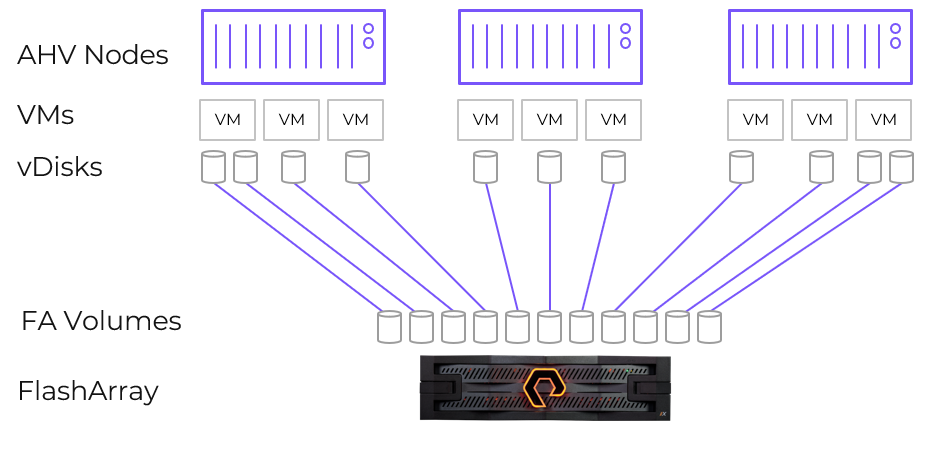
Nutanix now enables customers to run AHV compute clusters using enterprise-grade storage arrays while retaining the operational simplicity of Prism, AHV, and NCM. Pure Storage’s integration builds on the foundation established with PowerFlex, but expands the addressable market significantly by bringing a leading flash platform into the Nutanix operating model.
Why is this strategically important?
- It confirms that Nutanix is committed to disaggregated architectures, not just compatible with them. What began with Dell PowerFlex as a single integration has matured into a structured approach. Nutanix will support multiple external storage ecosystems while providing a consistent compute and management experience.
- It gives customers real choice in storage without fragmenting operations. With Pure Storage joining PowerFlex, Nutanix now supports two enterprise storage platforms that are widely deployed in existing environments. Customers can keep their existing tier-1 arrays and still modernize compute, hypervisor, and operations around AHV and Prism.
- It creates an on-ramp for VMware exits with minimal disruption. Many VMware customers own Pure FlashArray deployments or run PowerFlex at scale. With these integrations, they can adopt Nutanix AHV without replatforming storage. The migration becomes a compute and virtualization change and not a full infrastructure overhaul.
- It positions Nutanix as the control plane above heterogeneous infrastructure. The combination of NCI with PowerFlex and now Pure Storage shows that Nutanix is building an operational layer that unifies disparate architectures.
- It aligns modernization with financial reality. Storage refreshes and compute refreshes rarely align. Supporting multiple external arrays allows Nutanix customers to modernize compute operations first, defer storage investment, and transition into HCI only when it makes sense.
Nutanix has moved from a tightly defined HCI architecture to an extensible compute platform that can embrace best-in-class storage from multiple vendors.
Nutanix Cloud Clousters on Google Cloud – A Third Strategic Hyperscaler Joins the Story
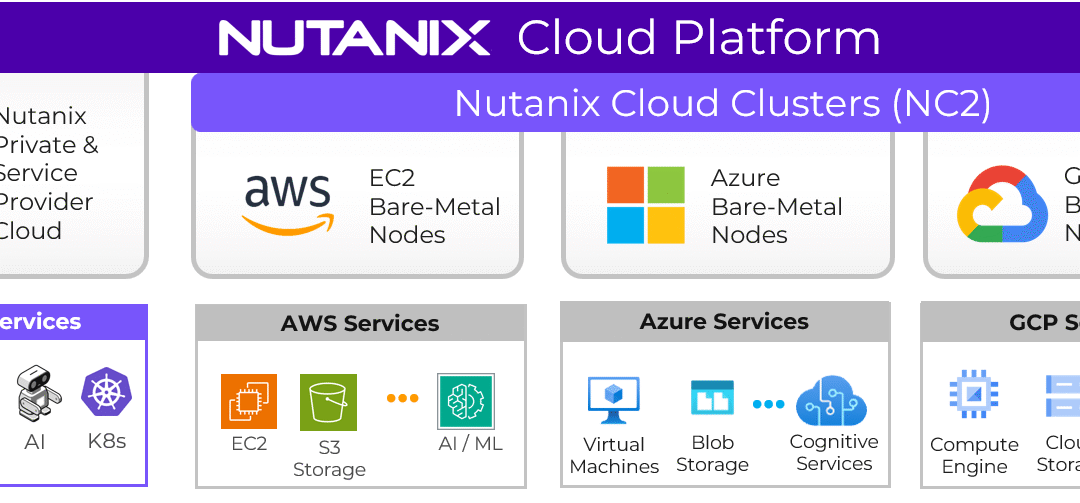
The general availability of NC2 on Google Cloud completes a strategic triangle. With AWS, Azure and now Google Cloud all supporting Nutanix Cloud Clusters (NC2), Nutanix becomes one of the very few platforms capable of delivering a consistent private cloud operating model across all three major hyperscalers. It fundamentally changes how enterprises can think about cloud architecture, mobility, and strategic independence.
Running NC2 on Google Cloud creates a new kind of optionality. Workloads that previously needed to be refactored or painfully migrated can now move into GCP without rewriting, without architectural compromises, and without inheriting a completely different operational paradigm. For many organizations, especially those leaning into Google’s strengths in analytics, AI, and data services, this becomes a powerful pattern. Keep the operational DNA of your private cloud, but situate workloads closer to the native cloud services that accelerate innovation.
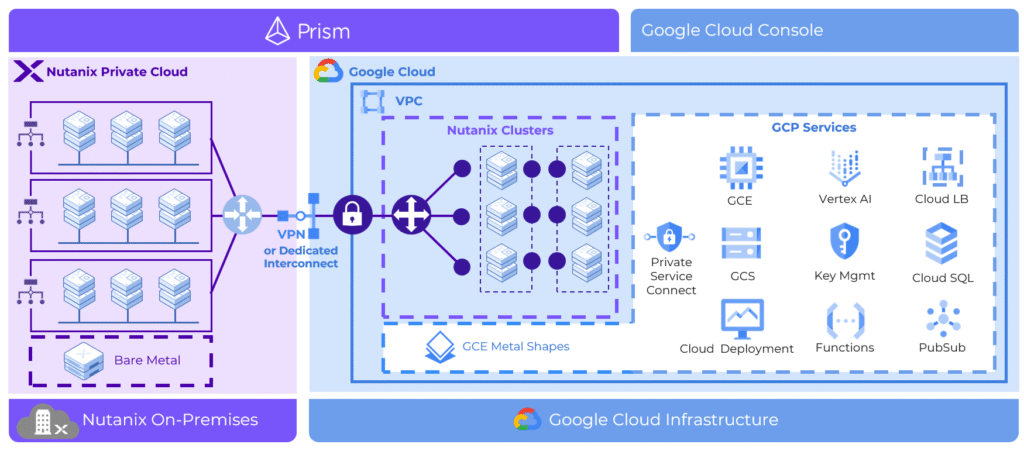
When an enterprise can run the same platform – the same hypervisor, the same automation, the same governance model – across multiple hyperscalers, the risk of cloud lock-in can be reduced. Workload mobility and cloud-exit strategies become a reality.
NC2 on Google Cloud is a sign of how Nutanix envisions the future of hybrid multi-cloud. Not as a patchwork of different platforms stitched together, but a unified operating fabric that runs consistently across every environment. With Google now joining the story, that fabric becomes broader, more flexible, and significantly more strategic.
Conclusion
Nutanix is removing the trade-offs, that enterprises once accepted as inevitable.
Most IT leaders aren’t searching for (new) features. They are searching for ways to reduce risk, control cost, simplify operations, and maintain autonomy while the world around them becomes more complex. Nutanix’s recent enhancements are structural. They chip away at the constraints that made traditional infrastructure unflexible and expensive.
The platform is becoming more open, more flexible, more distributed, and more sovereign by design.