
10 Things You Probably Didn’t Know About Nutanix

10 Things You Probably Didn’t Know About Nutanix

Nutanix is often described with a single word: HCI. That description is not wrong, but it is incomplete.

Over the last decade, Nutanix has evolved from a hyperconverged infrastructure (HCI) pioneer into a mature enterprise cloud platform that now sits at the center of many VMware replacement strategies, sovereign cloud designs, and edge architectures. Yet much of this evolution remains poorly understood, partly because old perceptions persist longer than technical reality.

Here are ten things about Nutanix that people often don’t know or underestimate.

1. Nutanix’s DNA is HCI, but the architecture has evolved beyond it

Nutanix was built on hyperconverged infrastructure. That heritage is important, because it shaped the platform’s operational model, automation mindset, and lifecycle discipline.

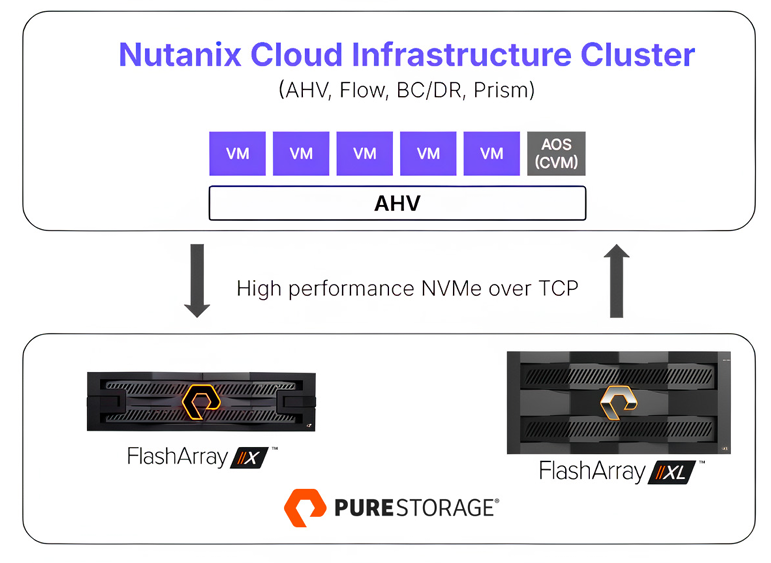
Over the last years, Nutanix deliberately opened its architecture. Today, compute-only nodes are a possibility, enabled through partnerships with vendors like Dell (PowerStore support for Nutanix is expected to enter early access in spring 2026, with general availability coming in summer 2026) and Pure Storage (for now). This allows customers to decouple compute and storage where it makes architectural or economic sense, without abandoning the Nutanix control plane.

This is Nutanix acknowledging that real enterprise environments are heterogeneous, and that flexibility matters.

2. A Net Promoter Score above 90

Nutanix has reported an NPS score consistently above 90 for several years. In enterprise infrastructure, that number is almost unheard of.

NPS reflects how customers feel after deployment, during operations, upgrades, incidents, and daily use. In a market where infrastructure vendors are often tolerated rather than liked, this level of advocacy is just unique and tells a story if its own.

It suggests that Nutanix’s real differentiation is not just technology, but operational experience. That tends to show up only once systems are running at scale.

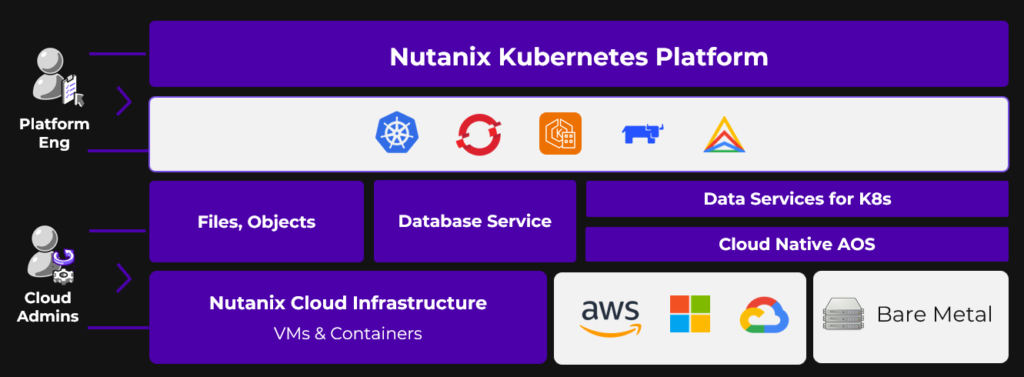
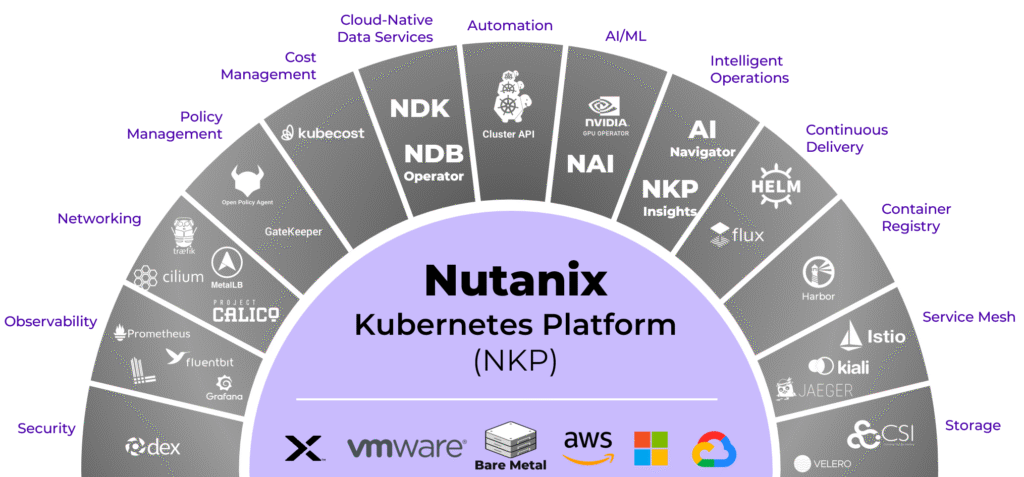
3. Nutanix Kubernetes Platform runs almost everywhere

Nutanix Kubernetes Platform (NKP) is often misunderstood as “Kubernetes on Nutanix”. That is only partially true.

NKP can run on:

  • Bare metal
  • Nutanix AHV
  • VMware
  • Public cloud infrastructure

Nutanix Cloud Native Platform

NKP was designed to abstract infrastructure differences rather than enforce platform lock-in. For organizations that already operate mixed environments, or that want to transition gradually, this matters far more than ideological purity.

In practice, NKP becomes a control layer for Kubernetes. That is especially relevant in regulated or sovereign environments where infrastructure choices are often political as much as technical.

4. Nutanix has matured from “challenger” to enterprise-grade platform

It’s honest to acknowledge that Nutanix wasn’t always considered enterprise-ready. In its early years, the company was widely admired for innovation and simplicity, but many large organizations hesitated because the platform, like all young software, had feature gaps, stability concerns in some use cases, and a smaller track record with mission-critical workloads.

That landscape has changed significantly. Over the past several years, Nutanix has steadily strengthened every axis of its platform. From virtualization and distributed storage to Kubernetes, security, and operations at scale. The company’s most recent financial results show that this maturity isn’t theoretical. Fiscal 2025 delivered 18 % year-over-year revenue growth, strong recurring revenue expansion, and Nutanix added thousands of new customers, including over 50 Global 2000 accounts, arguably its strongest annual new-logo performance in years. 

What this means in practice is that many enterprises that once saw Nutanix as a “challenger” now see it as a credible and proven alternative to VMware, and not just in smaller or departmental deployments, but across core data center and hybrid cloud estates.

The old maturity gap has largely disappeared. What remains is a difference of philosophy. Nutanix prioritizes operational simplicity, flexibility, and choice, without compromising the robustness that large organizations demand. And with increasing adoption among Global 2000 enterprises, that philosophy is proving not only viable but competitive at the highest levels of IT decision-making.

5. The “Nutanix is expensive” perception is outdated and often wrong

The idea that Nutanix is more expensive than competitors is one of the most persistent myths in the market. It was shaped by early licensing models and by superficial price comparisons that ignored operational and architectural differences.

Today, Nutanix offers multiple licensing models, including options that other vendors simply do not have.

For example, NCI-VDI for Citrix or Omnissa environments is licensed based on concurrent users (CCU) rather than physical CPU cores. That aligns cost directly with usage and not hardware density.

Even more interesting is NCI Edge, which is designed for distributed environments with smaller footprints (aka ROBO). It is licensed per virtual machine, with clear boundaries:

  • Maximum of 25 VMs per cluster
  • Maximum 96 GB RAM per VM

Consider a realistic example. An organization runs 250 edge sites. Each site has a 3-node cluster with 32 cores per node and hosts 20 VMs:

  • A core-based model would require licensing 24’000 cores
  • With NCI Edge, the customer licenses 5’000 VMs

It fundamentally changes the cost structure of edge and remote deployments. In a traditional core-based licensing model, effective costs might range from $100 to $140 per core for edge nodes. With NCI Edge, the effective per-core cost can drop to $60-80 (illustrative figures). This is not a marginal optimization, it’s huge.

Note: NCM Edge is a product that provides the same capabilities as NCM for edge use cases. NCM-Edge is also limited to a maximum of 25 VMs in a cluster.

6. Almost 90% of Nutanix customers now use AHV

Nutanix has always been fundamentally about HCI and AOS (Acropolis Operating System). From the beginning, the value was never the hypervisor itself, but the distributed storage, data services, and operational model built on top of it. Over time, Nutanix came to a clear conclusion: The hypervisor should be a commodity, not the value anchor of the platform. Out of this thinking, the perception, and later the expression, emerged that AHV is “free”.

No photo description available.

Today, AHV has become the dominant deployment model in the Nutanix ecosystem, with an adoption rate of 88%. This matters for two important reasons. First, it disproves the assumption that customers need to be pushed or incentivized to move to AHV. Second, it demonstrates that AHV is trusted to run mission-critical workloads at scale, across enterprises and service providers.

7. Nutanix is 100% channel-led

Nutanix does not sell directly to customers (for sure there are some exceptions :)). It is a channel-led vendor, by design, and that decision fundamentally shapes how the company operates in the market. Hence, channel commitment at Nutanix is a structural principle.

Partners are not treated as a fulfillment layer or a transactional necessity. They are core to how Nutanix delivers value – from architecture design and implementation to day-two operations, managed services, and long-term customer success. As a result, Nutanix has built one of the strongest partner and service provider ecosystems in the industry, with clear incentives, predictable rules, and room for partners to build sustainable businesses.

This stands in sharp contrast to the current direction of some other infrastructure vendors, where channel models have become more restrictive, less transparent, and increasingly centered around direct control. In that environment, partners often struggle with margin pressure, reduced influence, and uncertainty about their long-term role.

Nutanix takes a different approach. By staying channel-led, it enables local expertise, regional sovereignty, and trusted delivery models, which are especially critical in public sector, regulated industries, and markets where locality and compliance matter as much as technology.

8. MST and Cloud-Native AOS show how far Nutanix has moved beyond classic HCI

Most people associate Nutanix AOS with hyperconverged infrastructure and VM-centric deployments. What is far less known is how deeply Nutanix has evolved its data platform to address multi-cloud and cloud-native architectures.

One example is MST (Multi-Cloud Snapshot Technology). MST enables application-consistent snapshots to be replicated across heterogeneous environments, including on-premises infrastructure and public clouds. Unlike traditional disaster-recovery approaches that assume identical infrastructure on both sides, MST is designed for asymmetric, real-world scenarios. This makes it possible to use the public cloud as a recovery or failover target without re-architecting workloads or maintaining a second, identical private environment. 

MST diagram

In parallel, Nutanix has introduced Cloud Native AOS, which brings enterprise-grade storage and data services directly into Kubernetes environments. Instead of tying storage to virtual machines or specific infrastructure stacks, Cloud Native AOS runs as a Kubernetes-native service and can operate across diverse platforms. This allows stateful applications to benefit from Nutanix data services, such as snapshots, replication, and resilience, without forcing teams back into VM-centric models.

Together, MST and Cloud-Native AOS illustrate an important point. Nutanix is not simply extending HCI into new form factors. It is re-architecting core data services to work across clouds, infrastructures, and application models. These capabilities are often overlooked, but they are strong indicators of where the platform is heading — toward data mobility, resilience, and consistency across increasingly fragmented environments.

EKS Cluster

9. Nutanix SaaS without forcing SaaS

Nutanix offers SaaS-based services such as Data Lens and Nutanix Central. These services are also available on-premises, including for air-gapped environments.

This dual-delivery model recognizes that not all customers can or should consume control planes as public SaaS. 

10. Nutanix has more than a decade of real-world experience replacing VMware

Nutanix has operated alongside VMware for more than ten years, in many cases within the same environments. As a result, replacing vSphere is not a new ambition or a reactive strategy for Nutanix. It is just a long-standing and proven reality.

Equally important is the migration experience. Nutanix Move was built specifically to address one of the most critical challenges in any platform transition. It’s about getting workloads across safely, predictably, and at scale. Move supports migrations from vSphere, Hyper-V, AWS, and other environments, enabling phased and low-risk transitions rather than disruptive “big bang” projects. Beyond workload migration, Move can also translate NSX network and security policies into Nutanix Flow, addressing one of the most commonly cited blockers in VMware exit strategies.

Nutanix has spent more than a decade refining these aspects across thousands of customer environments, which is why many organizations today view it as a credible, de-risked alternative for the long term.

Conclusion

For organizations reassessing their infrastructure strategy, whether driven by VMware uncertainty, edge expansion, regulatory pressure, or cloud cost realities, Nutanix should be on the top of your list. It is a proven platform with a clear philosophy, a growing enterprise footprint, and more than a decade of hard-earned experience. If Nutanix is still on your shortlist as “HCI”, it may be time to look again, and this time at the full picture! 🙂 
Moving away from VMware to Nutanix makes sense when…

Moving away from VMware to Nutanix makes sense when…

You shouldn’t be asking “Which platform has the longest feature list?” but “What outcome justifies the cost of moving from one private cloud stack to another?“. This is precisely where many VMware by Broadcom customers find themselves today. While there are still many loyal VMware customers, there are other organizations that want or must re-evaluate their current situation. And a simple but often forgotten truth is this: a like-for-like platform replacement rarely makes sense.

Not because Nutanix cannot do what VMware does. It absolutely can! But because the economics and operational impact of migrating an entire virtual estate purely to reproduce the status quo will not automatically create value. Unless Broadcom’s new price structure forces the customer’s hand or the relationship with the vendor becomes unbearable for non-technical reasons, a one-to-one replacement is just a reaction, and not a strategic move.

A change of platform needs a reason that transcends replacement. It needs intent.

And this is where the conversation becomes interesting, because the moment a customer begins thinking beyond “keep everything the same”, Nutanix suddenly becomes much more than a substitute or alternative. It becomes a platform for a new chapter.

Application Modernization

It’s almost 2026 and guess what, most enterprises (still) live in a VM-centric world and some of them are just starting now to modernize applications, modernize operations, and converge their infrastructure and cloud strategies. So, they look at Kubernetes, container orchestration and DevOps practices not as “modern” anymore, but as mandatory capabilities for the next decade.

Trying to retrofit these ambitions into a purely VMware-centric future is possible, but rarely elegant. Costs accumulate. Tooling becomes fragmented. Operational models start to diverge.

Nutanix provides a clean path into a Kubernetes-native, cloud-architected operational model through Nutanix Kubernetes Platform (NKP) and Nutanix Cloud Infrastructure (NCI) as the unified foundation.

Nutanix Kubernetes Platform Open Source

If an organization wants to build for the next generation of workloads rather than the last, platform migration becomes a strategic investment. And the cost of change is suddenly justified by the long-term trajectory.

AI becomes real. Sovereignty becomes mandatory.

Over the past year, enterprise AI has evolved from theory to a board-level priority. However, deploying secure, compliant, and controlled GenAI infrastructure is not something legacy stacks were designed for. GPU clusters, high-throughput storage, inference pipelines, and air-gapped architectures. All these require a platform that is not only modern, but sovereign, composable and operationally manageable.

Nutanix Enterprise AI

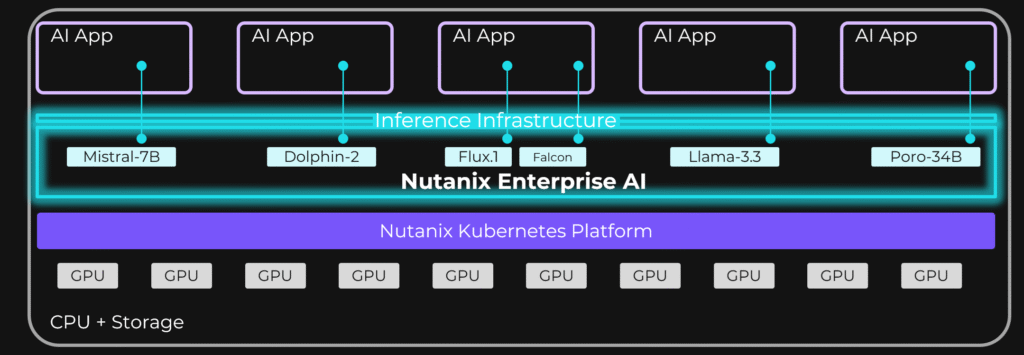
Nutanix offers a cohesive, GPU-ready, open ecosystem designed to host your own models, your own data, and your own AI stack.  Sovereign, isolated, and fully under your control.

Nutanix Enterprise AI (NAI) turns AI infrastructure into something deployable rather than experimental. Together with NCI and NKP, it forms an environment where customers can build internal AI factories without relying on hyperscalers or exposing sensitive data.

Flexibility in storage architecture

Recently, Nutanix announced support for external storage – starting with Dell and Pure Storage.

Nutanix and Pure Storage


For the first time, customers can bring their existing enterprise storage arrays into a Nutanix architecture without forcing a forklift replacement or abandoning multi-year investments.

This fundamentally changes the economics of a VMware-to-Nutanix transition. What used to be a full-stack change can now become an incremental evolution. Keep the storage infrastructure you already trust, maintain the performance characteristics your applications rely on, and modernize the compute and virtualization layer above it.

Nutanix is acknowledging that customers do not live in greenfield worlds, that not every journey starts with a clean slate, and that sovereignty and autonomy often require preserving existing assets rather than discarding them.

For customers who want to move away from VMware but cannot replace their storage systems, Nutanix now offers a transition path that aligns with financial and architectural realities. For customers planning application modernization or sovereign AI initiatives, the ability to combine dedicated storage arrays with NCI and NKP gives them the freedom to architect the right performance tiers for each workload without vendor lock-in.

Cost pressure meets VDI realities

Desktop virtualization has always been the domain where infrastructure complexity causes the most harm. VDI environments are sensitive, cost-intensive, and operationally unforgiving. If a customer is looking for a cheaper, simpler and more predictable platform for VDI, Nutanix becomes a compelling candidate and it offers an architectural shortcut by providing consolidated storage and compute, extremely fast storage performance, linear scaling, and dramatically simpler day-to-day operations. The cost-to-outcome ratio is hard to ignore.

Nutanix and Omnissa

In such scenarios, the platform transition is less about “leaving VMware” and more about optimizing the future economics of delivering virtual desktops with a more efficient stack.

Recently, Nutanix and Omnissa announced that Omnissa Horizon now fully supports Nutanix AHV.

Conclusion

Ultimately, the decision to move away from VMware (or any other vendor) should never be driven purely by frustration or speculation. It should be driven by clarity.

If the only goal is to continue exactly what you do today, with the same architecture and application landscape, then the cost of change often outweighs the benefits. Unless Broadcom pricing leaves no room for rational continuity.

Nutanix is about “accelerating”, and your decision shouldn’t be about “escaping”. And that distinction is what separates good decisions from expensive reactions.

When motivation is driven by evolution, Nutanix becomes a foundation for the next chapter of your digital strategy.

And that is exactly the moment when moving away from VMware begins to make profound sense.

Why the Sovereign AI Platform from Nutanix Ends the DIY Illusion

Why the Sovereign AI Platform from Nutanix Ends the DIY Illusion

AI has moved into every boardroom conversation. However, meaningful results don’t come from building everything from scratch. For enterprises and public organizations, sovereignty has become the real test of digital trust, and platforms like NCP, NKP, and NAI give an answer where others struggle.

Over the past year, enterprises and public institutions have increasingly tried to build their own AI platforms. The idea sounds compelling. You can run open-source large language models in-house, fine-tune them with proprietary data, and operate a fully controlled environment. In practice, this approach proves difficult.

The pace of change is relentless. Models evolve in weeks, tooling shifts every quarter, and lifecycle management is more complex than anticipated. Teams quickly discover that maintaining infrastructure, compliance, and updates requires far more resources than expected. What was meant to guarantee independence often ends in fragile prototypes that never scale.

True sovereignty is not (only) about doing everything internally but also about keeping control while relying on platforms that deliver the operational stability needed to run AI securely and at scale.

Nutanix Cloud Platform – The Sovereign Private Cloud Foundation

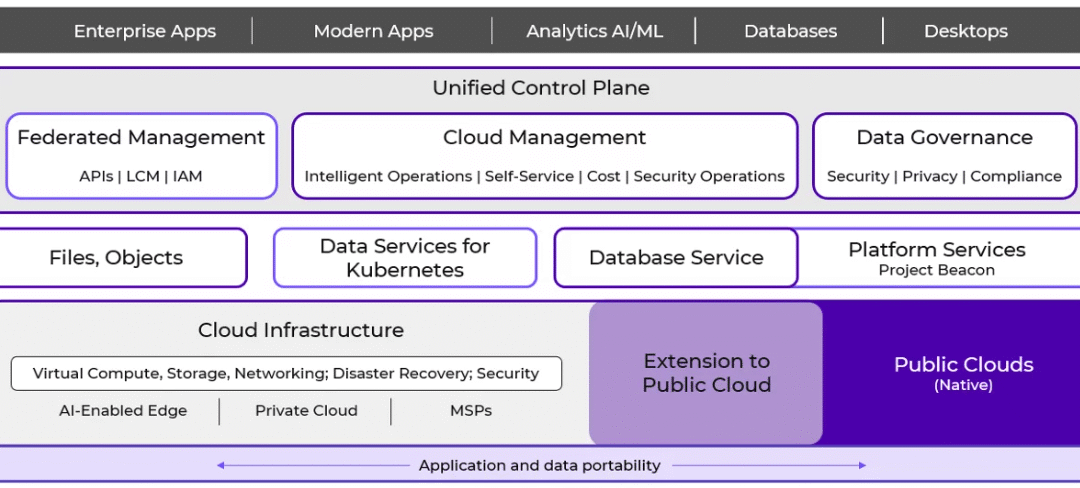
Nutanix Cloud Platform (NCP) provides exactly that. It offers a private cloud foundation that allows organizations to remain in control of infrastructure and data, while avoiding the trap of re-creating a hyperscaler internally.

Portfolio diagram

Sovereignty in this context means deciding who governs updates, how compliance is enforced, and which integrations are allowed. NCP delivers this flexibility through its modular architecture. Customers can adopt only the layers they need, combine them with open-source components, or run third-party solutions on the same platform.

For AI, where workloads evolve quickly and ecosystems are fragmented, this adaptability is critical. NCP ensures that the foundation remains under the customer’s control while still being ready for future demands.

Nutanix Kubernetes Platform – Orchestrating AI Workloads

Running AI workloads requires more than infrastructure. It depends on reliable orchestration, lifecycle management, and scalability. This is where Nutanix Kubernetes Platform (NKP) plays a central role.

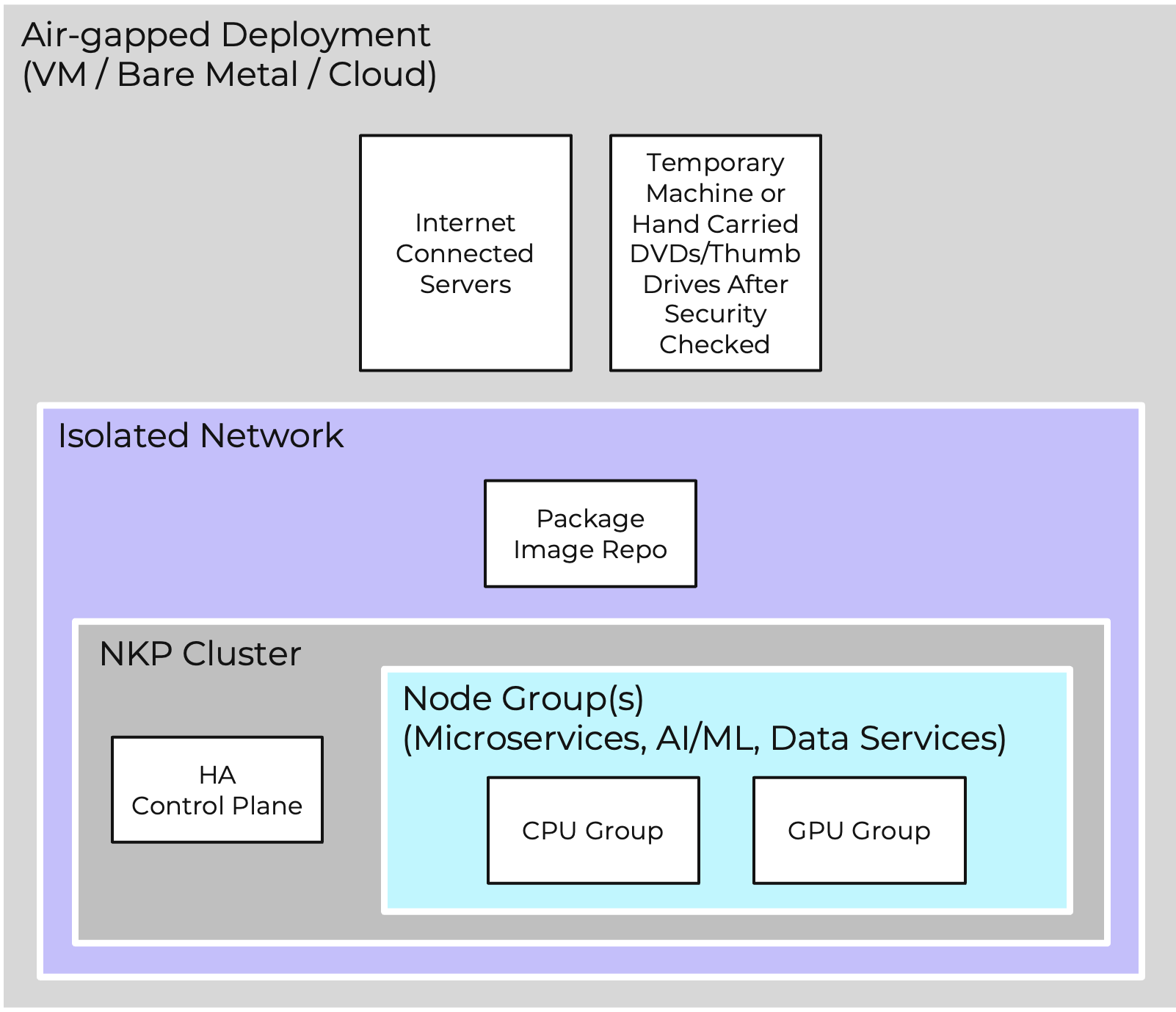
NKP in Air-gapped environment

NKP delivers an enterprise-ready Kubernetes distribution with consistent operations across environments. Instead of spending resources on patching and troubleshooting upstream clusters, teams can focus on building and deploying AI applications, whether retrieval-augmented generation (RAG) pipelines, vector databases, or fine-tuned models.

The combination of NCP and NKP means that organizations can operate AI in a compliant, sovereign environment, without being slowed down by the underlying complexity.

Nutanix Enterprise AI – Bringing Enterprise AI to Life

Nutanix Enterprise AI (NAI) builds on this foundation by making AI adoption tangible. It provides pre-validated, production-ready blueprints and integrations that simplify how AI infrastructure is deployed and scaled.

Image to represent Nutanix Enterprise AI is a comprehensive solution for all your AI apps and agents

Instead of each organization reinventing the wheel, NAI accelerates the journey by delivering tested architectures for GPU management, data pipelines, and model deployment. Combined with NCP and NKP, it creates a stack where AI workloads can move from experiment to production without losing compliance or control.

NAI ensures that sovereignty means having a trusted, repeatable path to make AI real.

Between Dependency and Autonomy

Enterprises today face two extremes. On one side lies the dependency on hyperscalers, with the risk of (multiple forms of) lock-in and limited control. On the other side stands full do-it-yourself, which consumes resources and rarely delivers production-ready results.

Sovereign AI requires balance. Buy the infrastructure foundation, partner on orchestration, and build only what creates real differentiation. This middle path is where NCP and NKP demonstrate their strength by enabling sovereignty without sacrificing agility.

A Future Still in the Making

The debate about AI and sovereignty is only at the beginning. Regulations will evolve, compliance requirements will tighten, and technology stacks will keep changing. What is clear today? Organizations that embed sovereignty into their AI strategy from the start will be better positioned for the future.

With NCP, NKP, and NAI, enterprises gain a foundation where sovereignty is designed in and adaptability is preserved. That makes them enablers of sustainable AI strategies in an era where control and trust are as important as innovation itself.

Why Workloads Are Really Repatriating to Private Cloud and How to Prepare for AI

Why Workloads Are Really Repatriating to Private Cloud and How to Prepare for AI

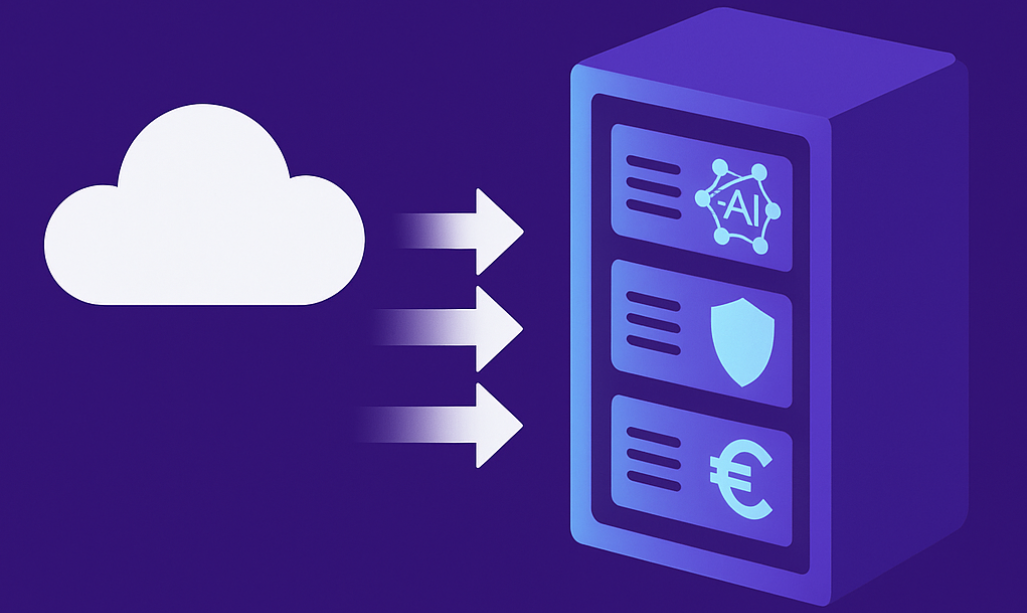
In the beginning, renting won. Managed services and elastic capacity let teams move faster than procurement cycles, and the “convenience tax” felt like a bargain. A decade later, many enterprises have discovered what one high-profile cloud exit made clear: The same convenience that speeds delivery can erode margins at scale. That realization is driving a new wave of selective repatriation, moving the right workloads from hyperscale public clouds back to private cloud platforms, while a second force emerges simultaneously. AI is changing what a data center needs to look like. Any conversation about bringing workloads home that ignores AI-readiness is incomplete.

What’s really happening (and what isn’t)

Repatriation today is targeted. IDC’s Server and Storage Workloads Survey found that only ~8-9% of companies plan full repatriation. Most enterprises bring back specific components like production data, backup pipelines, or compute, where economics, latency, or exit risk justify it.

Media coverage has sharpened the picture. CIO.com frames repatriation as strategic workload placement rather than a retreat. InfoWorld’s look at 2025 trends notes rising data-center use even as public-cloud spend keeps growing. Forrester’s 2025 predictions echo the co-existence. Public cloud expands, private cloud thrives alongside it.  Hybrid is normal. Sovereignty, cost control, and performance are the levers. 

And then there are the headline case studies. 37signals (Basecamp/HEY) publicized their journey off AWS – deleting their account in 2025 after moving storage to on-prem arrays and citing seven-figure annual savings on S3 alone. Whether or not your estate looks like theirs, it crystallized the idea that the convenience premium can outgrow its value at scale.

Why the calculus changed

Unit economics at scale. Per-unit cloud pricing that felt fine at 100 TB looks different at multiple PB, especially once you add data egress, cross-AZ traffic, and premium managed services. Well-understood examples (Dropbox earlier) show material savings when high-volume, steady-state workloads move to owned capacity. 

Performance locality and control. Some migrations lifted and shifted latency-sensitive systems into the wrong place. Round-trip times, noisy neighbors, or throttling can make the public cloud an expensive place to be for chatty, tightly coupled apps. Industry coverage repeatedly points to “the wrong workload in the wrong spot” as a repatriation driver. 

Sovereignty and exit risk. Regulated industries must reconcile GDPR/DORA-class obligations and the US CLOUD Act with how and where data is processed. The mid-market is echoing this too. Surveys show a decisive tilt toward moving select apps for compliance, control, and resilience reasons. 

FinOps maturity. After a few budgeting cycles, many teams have better visibility into cloud variability and the true cost of managed services. Some will optimize in-place, others will re-platform components where private cloud wins over a 3-5 year horizon.

Don’t bring it back to a 2015 data center

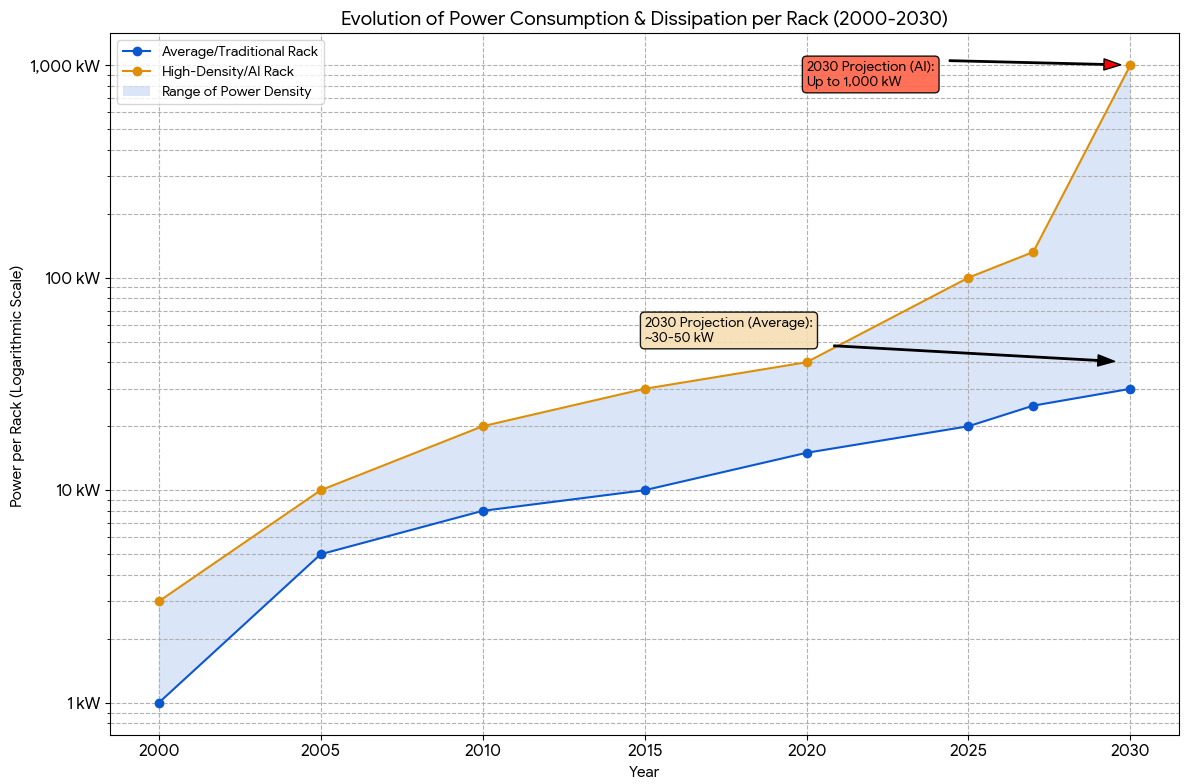
Even if you never plan to train frontier models, AI has changed the physical design targets. Racks that once drew 8-12 kW now need to host 30-50 kW routinely and 80-100+ kW for dense GPU nodes. Next-gen AI racks can approach 1 MW per rack in extreme projections.

Evolution of power consumption & dissipation per rack (2000-2030)

Image credit: Lennox Data Center Solutions

Air alone won’t be enough. Direct-to-Chip or immersion liquid cooling, higher-voltage distribution, and smarter power monitoring become minimum requirements. European sites face grid constraints that make efficiency and modular growth plans essential. 

This is the retrofit conversation many teams are missing. If you repatriate analytics, vector databases, or LLM inference and can’t cool them, you’ve just traded one bottleneck for another.

How the analysts frame the decision

A fair reading across recent coverage lands on three points:

  1. Hybrid wins. Public cloud spend grows, and so do private deployments, because each has a place. Use the public cloud for burst, global reach, and cutting-edge managed AI services. Use the private cloud for steady-state, regulated (sovereign), chatty, or data-gravity workloads.
  2. Repatriation is selective. It’s about fit. Data sets with heavy egress, systems with strict jurisdiction rules, or platforms that benefit from tight locality are top candidates.
  3. AI is now a first-order constraint. Power, cooling, and GPU lifecycle management change the platform brief. Liquid cooling and higher rack densities stop being exotic and become practical requirements.

Why Nutanix is the safest private cloud bet for enterprises and the regulated world

If you are going to own part of the stack again, two things matter: Operational simplicity and future-proofing. This is where Nutanix stands out.

A single control plane for private, hybrid, and edge. Nutanix Cloud Platform (NCP) lets you run VMs, files/objects, and containers with one operational model across on-prem and public cloud extensions. It’s built for steady-state enterprise workloads and the messy middle of hybrid.

Kubernetes without the operational tax. Nutanix Kubernetes Platform (NKP), born from the D2iQ acquisition, prioritizes day-2 lifecycle management, policy, and consistency across environments. If you are repatriating microservices or building AI micro-stacks close to data, this reduces toil.

AI-ready from the hypervisor up. AHV supports NVIDIA GPU passthrough and vGPU, and Nutanix has published guidance and integrations for NVIDIA AI Enterprise. That means you can schedule, share, and secure GPUs for training or inference alongside classic workloads, instead of creating a special-case island.

Data services with immutability. If you bring data home, protect it. Nutanix Unified Storage (NUS) provides WORM/immutability and integrates with leading cyber-recovery vendors, giving you ransomware-resilient backups and object locks without bolt-on complexity. 

Enterprise AI without lock-in. Nutanix Enterprise AI (NAI) focuses on building and operating model services on any CNCF-certified Kubernetes (on-prem, at the edge, or in cloud) so you keep your data where it belongs while retaining choice over models and frameworks. That aligns directly with sovereignty programs in government and regulated industries.

A Full-Stack Platform for Private AI

You get a private cloud that behaves like a public cloud where it matters, including lifecycle automation, resilience, and APIs. Under your control and jurisdiction.

Designing the landing zone

On day zero, deploy NCP as your substrate with AHV and Nutanix Unified Storage. Enable GPU pools on hosts that will run inference/training, and integrate NKP for container workloads. Attach immutable backup policies to objects and align with your chosen cyber-recovery stack. As you migrate, standardize on one identity plane and network policy model so VMs and containers are governed the same way. When you are ready to operationalize AI services closer to data, layer NAI to package and run model APIs with the same lifecycle tooling you already know.

The bottom line?

Repatriation is the natural correction after a decade of fast, sometimes indiscriminate, lift-and-shift, and not an anti-cloud movement. The best operators are recalibrating placement. AI turns this from a pure cost exercise into an infrastructure redesign. You can’t bring modern workloads home to a legacy room.

If you want the private side of that hybrid story without rebuilding a platform team from scratch, Nutanix is the safe choice. You get a single control plane for virtualization, storage, and Kubernetes, immutable data services for cyber-resilience, proven GPU support, and an AI stack that respects your sovereignty choices. That’s how you pay for convenience once, not forever, and how you make the next decade less about taxes and more about outcomes.