In my first five months at Nutanix, I have had dozens of conversations across the Swiss market. From federal organizations to cantonal institutions, from service providers to highly regulated environments. On paper, these discussions look completely different – different architectures, different priorities, and different timelines.
It took me a while to realize it, but there was a clear pattern. Regardless of size or sector, the same underlying questions keep surfacing, no matter if we were talking about a 1’000-, 4’500-, or 20’000-core infrastructure. And more interestingly, most of these questions are not about features or technical capabilities, these questions came later in the discussions.
Most questions are about risk, cost and control, and sometimes about sovereignty. It all has to do with certainty, doubts, stability and predictability.
So, it’s less about the available alternatives per se. Customers are trying to understand what staying actually means, what risk this implies.
1) Isn’t switching too risky?
This is one of the questions that appear very early when meeting prospects. Sometimes even right after the introduction before any real discussion has started.
It’s a natural reaction. For a long time, staying on VMware was the safest choice and there was no real reason to reconsider it.
But VMware is not “VMware” anymore, it is Broadcom now. So, what many organizations are experiencing today is not instability in their infrastructure, but the conditions around it. There is not one single customer that is telling me that “VMware” is not performing as expected and just great technology.
For many customers, especially those in regulated industries, it’s about predictability and control. Therefore staying (with VMware) is no longer automatically the safest option anymore.
What I see in practice is, that IT organizations quickly move away from the idea of a distruptive “big bang” migration. Instead, they start thinking in phases and use cases, and move workloads step by step. Systems run in parallel and confidence builds gradually. The projects that I have won are VDI and edge use cases. Larger projects with larger infrastructure take more time.
So, what’s the learning? While I understand why customers ask “isn’t switching too risky”, it’s just the wrong question.
The better question would be: What’s the risk of staying and how do we move without taking unnecessary risk?
From there, the conversation almost inevitably moves to cost.
2) Is Nutanix really cheaper?
Sounds like simple question, right? A number-to-number comparison, a classic price discussion. It’s anything but simple.
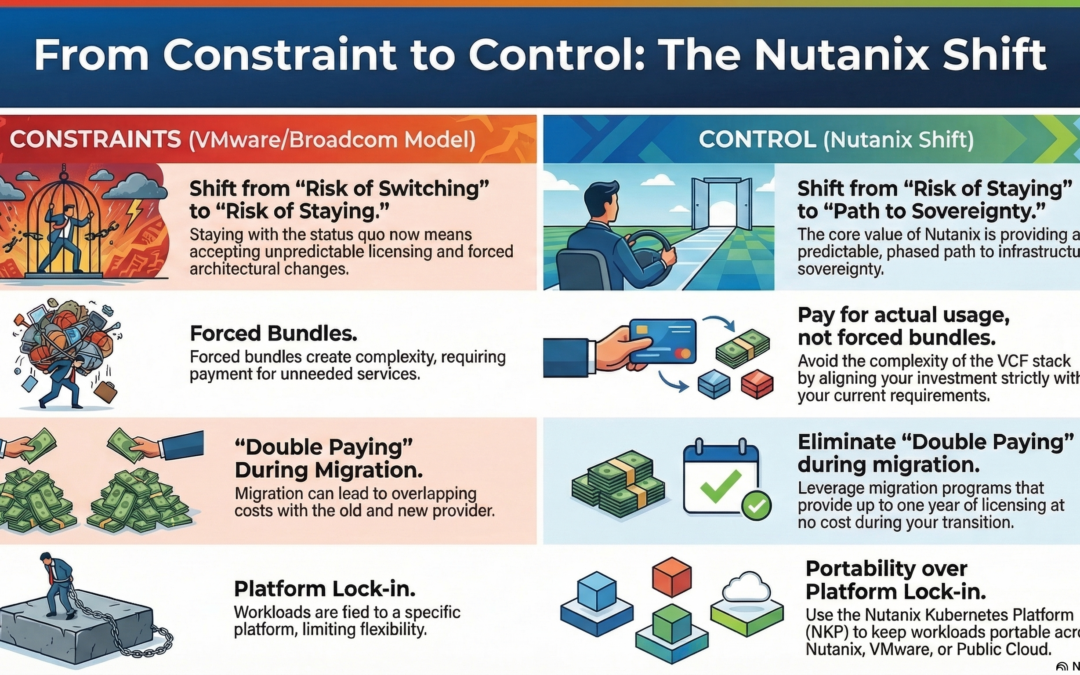
Because what most organizations are comparing is not two equivalent scenarios. They are comparing what they used to pay for VMware with what they might pay for something new. And that creates a distorted baseline from the very beginning. With Broadcom, at least in Switzerland, there is no more VMware vSphere Foundation (VVF) or vSphere Enterprise Plus standalone. You can only get VMware vSphere Standard (VVS) or VMware Cloud Foundation (VCF).
On paper, that sounds like simplification and in practice, it introduces a different kind of complexity. Because suddenly, organizations are not just buying what they need. They are buying what is included.
In many of the discussions I have had, customers admit that they are not using the full breadth of the VCF stack (even they have the VCF subscription. A lot of those VMware customers only use vSphere, some of them vSAN, and the most of them use Aria Operations. No NSX and no Aria Automation. And if you need advanced security features like micro-segmentation, you need an add-on for $200 (list price).
You can compare Nutanix against the entire VCF bundle. In that case, the question becomes “Can Nutanix replace everything that is included?”.
Or you can compare Nutanix against what you are actually using today. And suddenly, the picture changes. Dramatically.
Both perspectives are valid, but they lead to very different conclusions – commercially and strategically.
Let me rephrase the question, which now becomes: Why am I paying for functionality I don’t need?
This is something I explored in more detail in my recent article “Beyond the Price Tag – Why Organizations Choose Nutanix” The core idea is simple. Cost is rarely just about the price per core or the discount level. In the end it is about how closely your investment aligns with your actual requirements.
With Nutanix, you don’t start with everything and try to justify it afterwards, and you can start with what you actually need. And then you expand, step by step, where it creates value.
It sounds like a small difference, but in practice it changes the entire commercial logic.
3) Don’t we end up paying twice during the migration?
It’s a fair concern. Running two environments in parallel is often unavoidable during a transition. Without specific support, that can mean carrying two full licensing models at the same time.
This is exactly where Nutanix has taken a very pragmatic approach. Through its migration programs, customers can receive up to one year of Nutanix licensing at no additional cost during the transition period.
That doesn’t eliminate the complexity of a migration, but it removes a key barrier. It gives organizations time. And most importantly, it allows them to do this without being penalized financially for taking a careful approach.
4) We don’t have Nutanix skills
Over the past months, one pattern has become very clear. Broadcom is not just repositioning VMware commercially, but it is standardizing it architecturally. Everything points in the same direction: VMware Cloud Foundation is no longer an option. It is the only option.
And if you look at the publicly available information, this trajectory becomes even more tangible. Current indications suggest that support for vSphere 8.x and VCF versions not aligned with vSphere 9 will eventually come to an end. Which effectively means that, from around October 2027 onwards, unless Broadcom changes course again, customers will only be able to buy and deploy VCF 9.x.
In other words, the path forward is already being defined.
Now, to be fair, there are customers for whom this aligns well. Organizations that have already embraced VCF, invested in NSX, automation, and the broader stack, for them, this is a continuation of a journey they have consciously chosen.
But they are not the majority.
Most environments I see across Switzerland are still far from a fully adopted VCF architecture. They are running vSphere at scale, often with external storage and networking, established operational models, and teams that are deeply skilled in what they do today.
And this is exactly where the concern about “Nutanix skills” usually comes up. “Do we have the people for this?”
The reality is that Nutanix does not require you to throw away everything your teams have learned over the past 10 or 15 years. Quite the opposite.
The fundamental principles remain the same. You are still running virtual machines, designing clusters, ensuring availability, managing storage policies, operating networks, and securing workloads. Concepts like high availability, lifecycle management, capacity planning, and operational governance don’t disappear.
In fact, many VMware engineers adapt to Nutanix much faster than expected. Why? Because Nutanix deliberately simplified the operational model. Instead of stitching together compute, storage, and networking from different layers and tools, Nutanix brings these capabilities into a single, integrated platform.
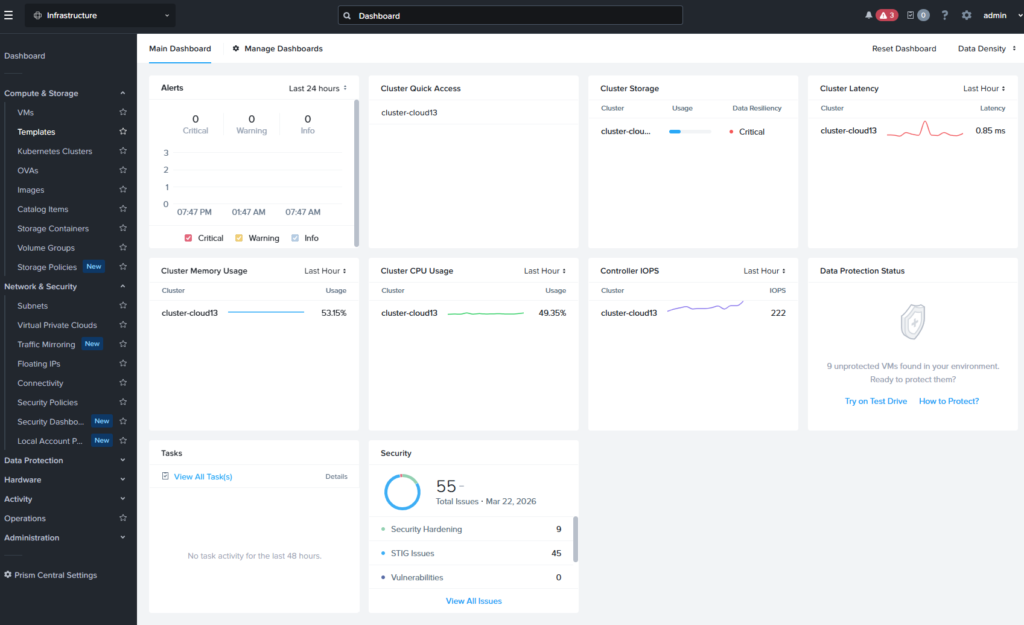
So yes, adopting Nutanix requires learning. But let’s be honest, so does adopting VCF. You need to be aware that moving to VCF is not just a licensing change. It includes an operational transformation. VCF also means new skills, new processes, new dependencies, and a new operational model.
So while Broadcom’s vision is actually quite clear – and, in many ways, understandable – it comes with consequences. The vision is to deliver a private cloud platform and a model where individual product names fade into the background, and what matters are capabilities. Compute, storage, networking, security, and automation are delivered as an integrated service layer, and VMware is becoming more like a public cloud. Conceptually, that makes sense to me.
You are adopting a new operating paradigm. The only real advantage compared to moving to a public cloud like Azure is, that your virtual machine format remains the same. Your VMs don’t need to be converted. But beyond that, the effort is comparable:
- You still need to redesign your architecture
- You still need to rethink networking and security
- You still need to retrain your teams
- You still need to plan and execute a structured migration
And this is exactly where the conversation reconnects with the themes we discussed earlier (cost, risk, control).
5) Isn’t Nutanix doing the same as Broadcom?
Yes, Nutanix absolutely offers a private cloud platform that can run in the data center, at the edge, or in the public cloud. So, in terms of vision, both VMware (under Broadcom) and Nutanix are heading towards a similar destination: A cloud-like operating model for on-premises environments.
Before the Broadcom era, VMware was known for something very specific: Modularity
With Nutanix, you can absolutely consume the full private cloud platform. But you don’t have to.
Organizations can pick and choose exactly what they want to deploy:
- A VDI environment? Use NCI‑VDI
- An edge cluster with minimal footprint? Use NCI‑Edge for small‑scale, distributed deployments
- A full enterprise platform spanning multiple sites? Deploy NCI Ultimate, NCM, Unified Storage, and Database Service as needed
6) Is Nutanix enterprise-ready?
A few years ago, that would have been a fair and important concern.
Back then, Nutanix was still perceived by many as a strong challenger. Innovative, yes. Promising, definitely. But not always seen as the default choice for the most critical, large-scale environments.
Is Hyper-V enterprise-ready? Is Azure Local enterprise-ready? What about newer or increasingly popular options like Proxmox?
The answer, in most cases, is simply assumed. And yet, if we take a step back, the question itself is more about perception.
Because Nutanix has been in the market for well over a decade. Its hypervisor, AHV, has been running production workloads for more than ten years. It is not new, it is not experimental, it is not an emerging technology trying to find its place.
It is established!
And that is reflected not only in customer adoption, but also in how the market evaluates the platform. Nutanix has consistently been positioned in the top-right quadrant of the Gartner Magic Quadrant for Distributed Hybrid Infrastructure.
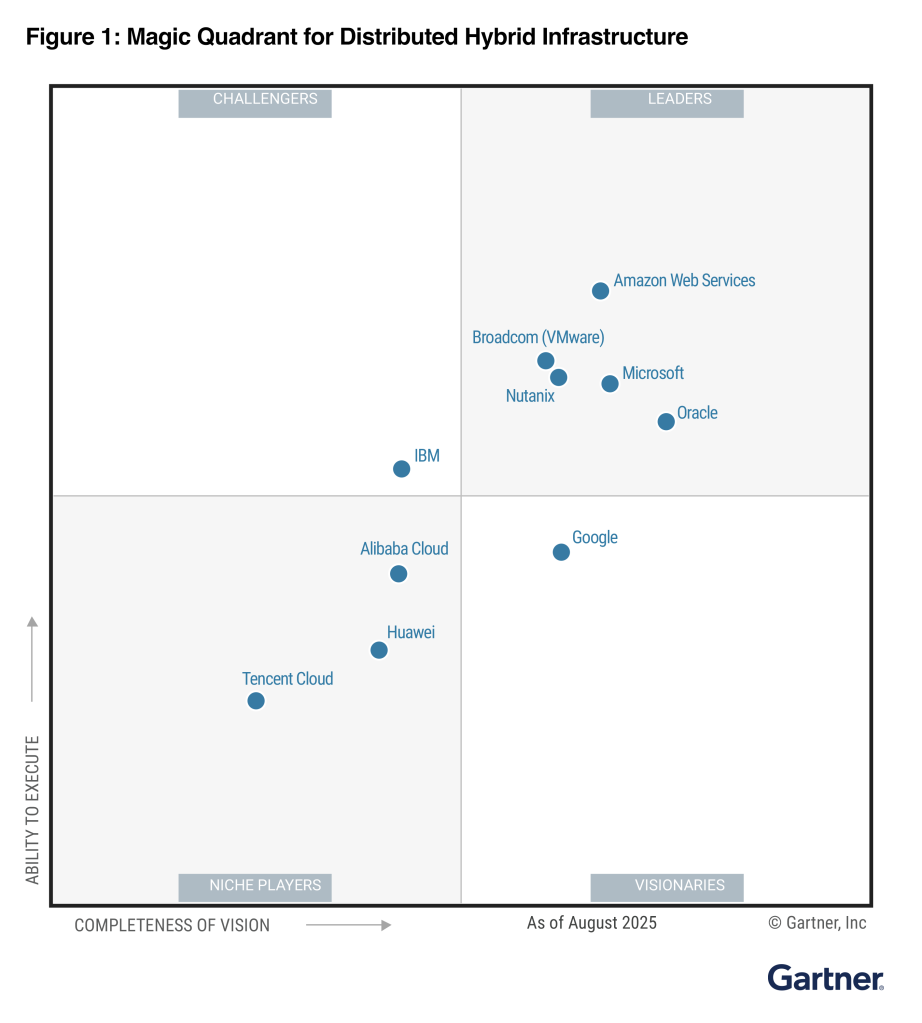
By any objective measure, Nutanix has already crossed the “enterprise-ready” threshold a long time ago.
7) Are we just replacing one dependency with another?
It’s a fair question, and probably one of the most important ones in the entire discussion. Because if the last few years have shown anything, it’s that lock-in is no longer an abstract concept.
No platform is completely free of dependencies. There is no such thing as a truly neutral infrastructure stack. Every decision introduces some form of coupling – to a vendor, to an architecture, to an operating model.
Dependencies exist, always. That’s not the important part. It’s about where they sit and how much control you retain over them. And this is exactly where the conversation becomes more interesting.
As discussed earlier, architectures are becoming more opinionated, more predefined, more aligned to a single operating model. Which means the dependency moves downwards into the foundation.
Nutanix, in contrast, shifts that balance towards the application layer. And this is where Kubernetes becomes important.
Because once applications are containerized and orchestrated through Kubernetes, the underlying infrastructure starts to matter less. Not irrelevant, but less dominant. Workloads become more portable, deployment models become more consistent, and the ability to move between environments becomes an option.
Nutanix Kubernetes Platform (NKP) provides an integrated way to run and manage Kubernetes across environments, without forcing customers into a specific cloud or infrastructure model. It aligns with the broader idea of hybrid and multi-cloud, but in a way that keeps operational control with the customer.
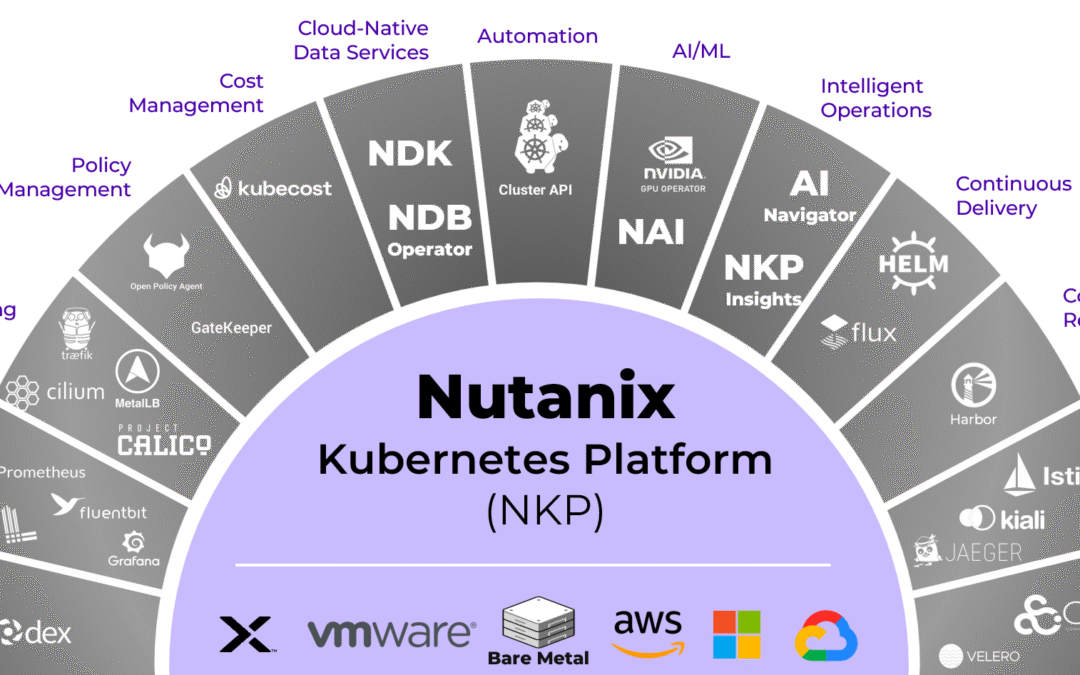
Replacing one platform with another is not inherently solving lock-in. But repositioning where dependencies sit, that’s ultimately what many organizations are looking for. Again, it’s about having the ability to stay on control. Because NKP is not tied to a single infrastructure backend:
- It can run on Nutanix
- It can run on VMware infrastructure
- It can run in public cloud environments
- It can even run directly on baremetal
Compare that to more tightly integrated approaches like the vSphere Kubernetes Service (VKS). VKS is deeply embedded into the vSphere ecosystem. It works well as long as you remain within that environment. But it is, by design, not portable beyond it. And that brings us back to the core point.
Lock-in is not eliminated by choosing a different vendor. It is reduced when your most critical layers are no longer restricted to a single environment.
How easily can you change tomorrow?
8) What if Nutanix gets acquired as well?
Another question has started to surface more frequently. It usually comes a bit later in the conversation, once the technical fit is understood, and once the commercial discussion has taken shape.
It’s a question that reflects the current mood in the market, and I have to admit it’s a valid one. Because the last few years have shown that ownership changes can have real consequences. They can reshape pricing models, redefine product strategies, and fundamentally alter the relationship between vendor and customer.
This question often leads to the wrong conclusion. We have to understand that the issue with VMware was not the acquisition itself. Acquisitions happen and they are part of how the technology industry evolves. The real issue was the impact that followed:
- The shift in pricing
- The restructuring of packaging
- The reduced flexibility
- And, ultimately, the feeling among many customers that control has moved away from them
That is what triggered the current wave of re-evaluation. So, when customers ask whether the same could happen elsewhere, they are not really asking about ownership. They are asking about exposure. If we follow that line of thinking consistently, the question doesn’t stop at Nutanix. You could ask the same about almost any platform in the market. What if Proxmox gets acquired? What if a hyperscaler changes its pricing model or service terms? What if an open source project shifts direction because of new commercial backing?
There is no scenario in which a platform is completely immune to change. And that is exactly my point. Trying to eliminate that risk entirely is not realistic.
9) AHV is not open source, is that a risk?
Nutanix’s Acropolis Hypervisor (AHV) is built on KVM, one of the most widely used open-source hypervisors out there. The foundation is open, and what Nutanix does is take that foundation and turn it into something that is actually operable at scale.
Open source sounds like freedom. And in some cases, it absolutely is. But in many real-world environments, it also means something else:
- More components
- More integration work
- More lifecycle management
- More responsibility on your own teams
- Especially at the infrastructure layer
Running a fully open source stack often means you are effectively building your own platform. You are combining a hypervisor, storage, networking, automation, and then making sure everything works together, stays updated, remains secure, and is supported when something breaks. That can be the right approach, but only if you actually want to operate like that.
At the infrastructure layer, especially in virtualization, open source rarely creates meaningful strategic advantage. The hypervisor has become a mature, almost commoditized component. Whether it’s KVM, AHV, Hyper-V, or ESXi. They all solve the same fundamental problem, and they solve it well.
Open source creates the most value where differentiation happens. And that is not at the bottom of the stack. It’s at the top, at the application layer. This could be Kubernetes or building open source applications (think about OpenDesk or Nextcloud).
10) What about sovereignty?
Sovereignty is not a feature you can simply “add” to a platform. And more importantly, it’s not just a hyperscaler problem (anymore). This is something I already explored in a previous article – the idea that dependency doesn’t suddenly disappear just because infrastructure runs on-premises or in a private cloud. You can still be deeply dependent on a vendor’s licensing model, roadmap, and architectural decisions.
There is one dimension of sovereignty that stands out above all others in current customer conversations: Economic sovereignty.
For many existing Broadcom customers, this has become the most immediate and tangible pain point:
- Not data residency
- Not compliance
- Not even technical capability
But cost predictability and the loss of it. And that brings us back to the platform.
The ability to maintain economic sovereignty is directly linked to how flexible your architecture is. If your platform enforces a predefined bundle, a fixed operating model, and limited alternatives, then your room to negotiate and adapt becomes smaller over time. If, on the other hand, your platform allows you to scale components independently, choose where workloads run, and avoid unnecessary dependencies, then you retain leverage.
Nutanix runs on-premises and in service provider environments. It also runs in public clouds (Nutanix NC2).
With the Nutanix Elevate Service Provider Program (NESPP), Nutanix enables managed service providers to build and operate sovereign cloud platforms themselves.
If your platform gives you flexibility, technically and commercially, then sovereignty becomes achievable.
Not VMware versus Nutanix
And this is ultimately where the entire discussion converges. Because despite all the technical arguments, the pricing models, the migration paths, and the architectural considerations, this is not a story about VMware versus Nutanix. What I see in the market right now is something different – a shift in how organizations relate to their infrastructure:
- Control vs. dependency
- Predictability vs. uncertainty
- Choice vs. constraint
As I said before, dependency, in this context, is about exposure. Control, on the other hand, is not about owning everything or building everything yourself. And predictability (like trust), once lost, is difficult to rebuild.
If we help customers to ask different questions, the conversations change. It becomes less about selecting a product and more about defining a direction.
So, is your plan to adapt to change or to shape it?