
Why Nutanix Represents the Next Chapter

Why Nutanix Represents the Next Chapter

For more than two decades, VMware has been the backbone of enterprise IT. It virtualized the data center, transformed the way infrastructure was consumed, and defined the operating model of an entire generation of CIOs and IT architects. That era mattered, and it brought incredible efficiency gains. But as much as VMware shaped the last chapter, the story of enterprise infrastructure is now moving on. And the real question for organizations is not “VMware or Nutanix?”, but the real question is: how much control are you willing to keep over your own future?

The Wrong Question

The way the conversation is often framed, Nutanix against VMware,  misses the point entirely. Customers are not trying to settle a sports rivalry. They are not interested in cheering for one logo over another. What they are really trying to figure out is whether their infrastructure strategy gives them freedom or creates dependency. It is less about choosing between two vendors and more about choosing how much autonomy they retain.

VMware is still seen as the incumbent, the technology that defined stability and became the default. Nutanix is often described as the challenger. But in reality, the battleground has shifted. It is no longer about virtualization versus hyperconvergence, but about which platform offers true adaptability in a multi-cloud world.

The VMware Era – A Breakthrough That Belongs to the Past

There is no denying VMware’s historical importance. Virtualization was a revolution. It allowed enterprises to consolidate, to scale, and to rethink how applications were deployed. For a long time, VMware was synonymous with progress.
But revolutions have life cycles. Virtualization solved yesterday’s problems, and the challenges today look very different. Enterprises now face hybrid and multi-cloud realities, sovereignty concerns, and the rise of AI workloads that stretch far beyond the boundaries of a hypervisor. VMware’s empire was built for an era where the primary challenge was infrastructure efficiency. That chapter is now closing.

The Nutanix Trajectory – From HCI to a Distributed Cloud OS

Nutanix started with hyperconverged infrastructure. That much is true but it never stopped there. Over the years, Nutanix has steadily moved towards building a distributed cloud operating system that spans on-premises data centers, public clouds, and the edge.

This evolution matters because it reframes Nutanix not as a competitor in VMware’s world, but as the shaper of a new one. Think about it. Now, it’s about who provides the freedom to run workloads wherever they make the most sense without being forced into a corner by contracts, licensing, or technical constraints.

The Cost of Inertia

For many customers, staying with VMware feels like the path of least resistance. There are sunk costs, existing skill sets, and the comfort of familiarity, but inertia comes at a price. The longer enterprises delay modernization, the more difficult and expensive it becomes to catch up later.

The Broadcom acquisition has accelerated this reality. Pricing changes, bundled contracts, and ecosystem lock-in are daily conversations in boardrooms. Dependency has become a strategic liability. What once felt like stability now feels like fragility.

Leverage Instead of Lock-In

This is where Nutanix changes the narrative. It is not simply offering an alternative hypervisor or another management tool. It is offering leverage – the ability to simplify operations while keeping doors open.

With Nutanix, customers can run workloads on-premises, in AWS, in Azure, in GCP, or across them all. They can adopt cloud-native services without abandoning existing investments. They can prepare for sovereignty requirements or AI infrastructure needs without being tied to a single roadmap dictated by a vendor’s financial strategy.

That is what leverage looks like. It gives CIOs and IT leaders negotiation power. It ensures that the infrastructure strategy is not dictated by one supplier’s pricing model, but by the customer’s own business needs.

The Next Chapter

VMware defined the last era of enterprise IT. It built the virtualization chapter that will always remain a cornerstone in IT history. But the next chapter is being written by Nutanix. Not because it “beat” VMware, but because it aligned itself with the challenges enterprises are facing today: autonomy, adaptability, and resilience.

This chapter is about who controls the terms of the game. And for organizations that want to stay in charge of their own destiny, Nutanix represents the next chapter.

Why Sovereign Hybrid Multi-Cloud is the Future of Cloud in Europe

Why Sovereign Hybrid Multi-Cloud is the Future of Cloud in Europe

When people talk about cloud computing, the conversation almost always drifts toward the hyperscalers. AWS, Azure, and Google Cloud have shaped what we consider a “cloud” today. They offer seemingly endless catalogs of services, APIs for everything, and a global footprint. So why does Nutanix call its Nutanix Cloud Platform (NCP) a private cloud, even though its catalog of IaaS and PaaS services is far more limited?

To answer that, it makes sense to go back to the roots. NIST’s SP 800-145 definition of cloud computing is still the most relevant one. According to it, five essential characteristics make something a cloud: on-demand self-service, broad network access, resource pooling, rapid elasticity, and measured service. NIST then defines four deployment models: public, private, community, and hybrid.

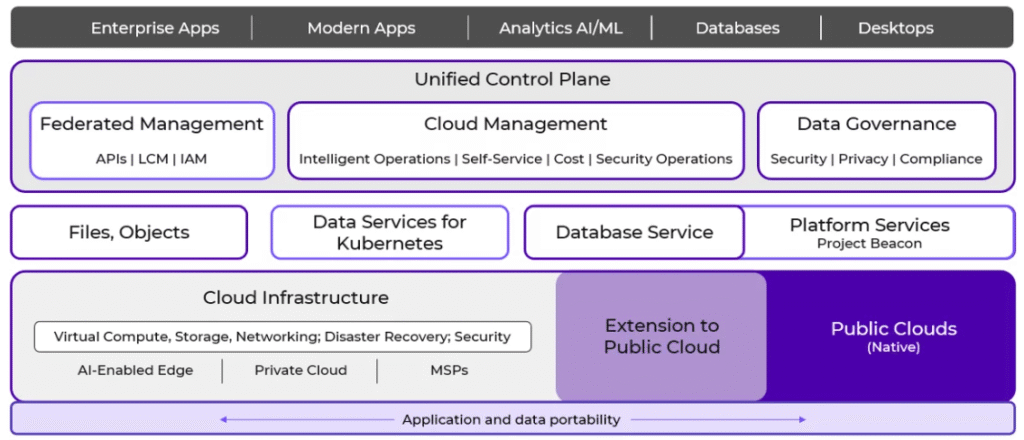
If you look at NCP through that lens, it ticks the boxes. It delivers on-demand infrastructure through Prism and APIs, it abstracts and pools compute and storage across nodes, it scales out quickly, and it gives you metering and reporting on consumption. A private cloud is about the deployment model and the operating characteristics, not about the length of the service catalog. And that’s why NCP rightfully positions itself as a private cloud platform.

Nutanix Cloud Platform Hybrid Multi-Cloud

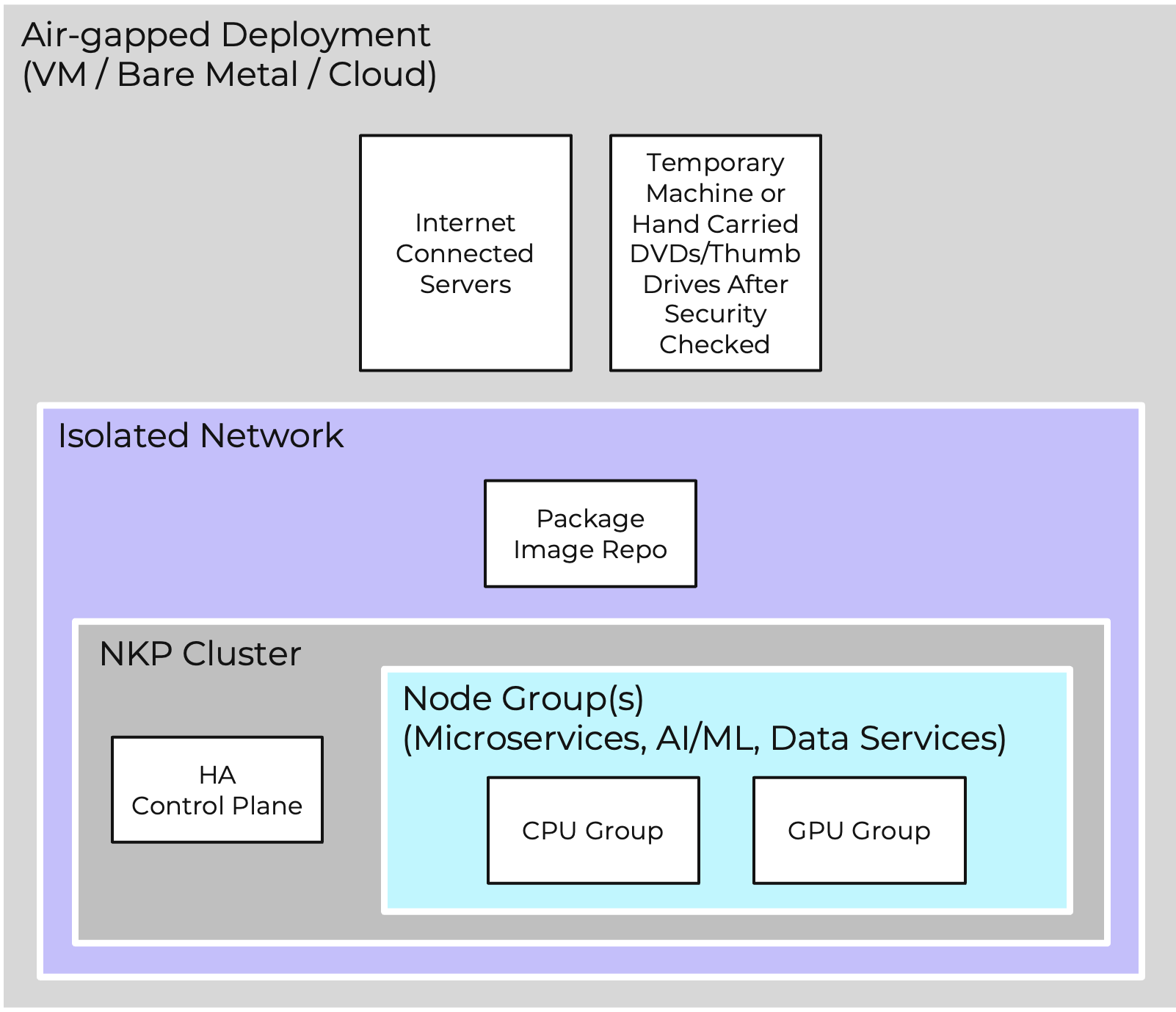
At the same time, it would be wrong to assume that private clouds stop at virtual machines and storage. Modern platforms are extending their scope with built-in capabilities for container orchestration, making Kubernetes a first-class citizen for enterprises that want to modernize their applications without stitching together multiple toolchains. On top of that, AI workloads are no longer confined to the public cloud. Private clouds can now deliver integrated solutions for deploying, managing, and scaling AI and machine learning models, combining GPUs, data services, and lifecycle management in one place. This means organizations are not locked out of next-generation workloads simply because they run on private infrastructure.

A good example is what many European governments are facing right now. Imagine a national healthcare system wanting to explore generative AI to improve medical research or diagnostics. Regulatory pressure dictates that sensitive patient data must never leave national borders, let alone be processed in a global public cloud where data residency and sovereignty are unclear. By running AI services directly on top of their private cloud, with Kubernetes as the orchestration layer, they can experiment with new models, train them on local GPU resources, and still keep complete operational control. This setup allows them to comply with AI regulations, maintain full sovereignty, and at the same time benefit from the elasticity and speed of a modern cloud environment. It’s a model that not only protects sovereignty but also accelerates innovation. Innovation at a different pace, but it’s still innovation.

Now, here’s where my personal perspective comes in. I no longer believe that the hyperscalers’ stretch into the private domain – think AWS Outposts, Azure Local, or even dedicated models like Oracle’s Dedicated Region – represents the future of cloud. In continental Europe especially, I see these as exceptions rather than the rule. The reality now is that most organizations here are far more concerned with sovereignty, control, and independence than with consuming a hyperscaler’s entire catalog in a smaller, local flavor.

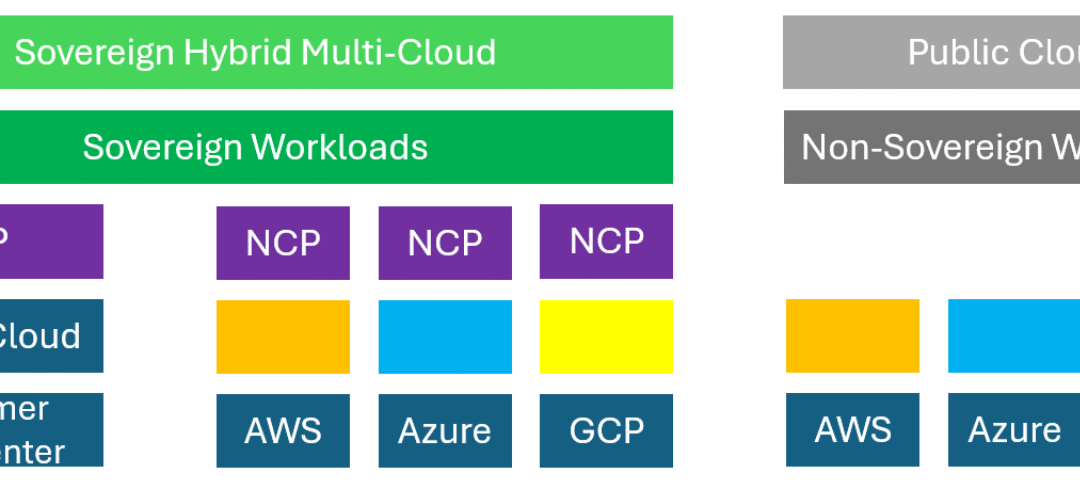
What I believe will be far more relevant is the rise of private clouds as the foundation of enterprise IT. Combined with a hybrid multi-cloud strategy, this opens the door to what I would call a sovereign hybrid multi-cloud architecture. The idea is simple: sovereign and sensitive workloads live in a private cloud that is under your control, built to allow quick migration and even a cloud-exit if needed. At the same time, non-critical workloads can live comfortably in a public cloud where an intentional lock-in may even make sense, because you benefit from the deep integration and services that hyperscalers do best.

And this is where the “exit” part becomes critical. Picture a regulator suddenly deciding that certain workloads containing citizen data cannot legally remain in a U.S.-owned public cloud. For an organization without a sovereign hybrid strategy, this could mean months of firefighting, emergency projects, and unplanned costs to migrate or even rebuild applications. But for those who have invested in a sovereign private cloud foundation, with portable workloads across virtual machines and containers, this becomes a controlled process. Data and apps can be moved back under national jurisdiction quickly (or to any other destination), without breaking services or putting compliance at risk. It turns a crisis into a manageable transition.

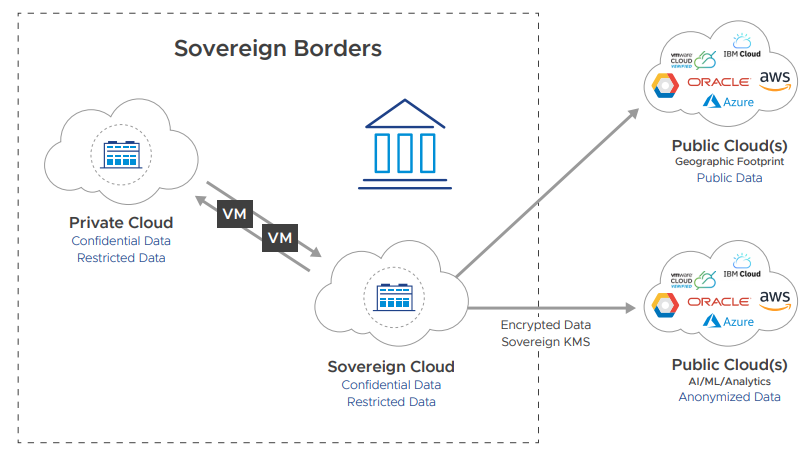
VMware Sovereign Cloud Borders

This two-speed model gives you the best of both worlds. Sovereignty where it matters, and scale where it helps. And it puts private cloud platforms like Nutanix NCP in a much more strategic light. They are not just a “mini AWS” or a simplified on-prem extension, but are the anchor that allows enterprises and governments to build an IT architecture with both freedom of choice and long-term resilience.

While public clouds are often seen as environments where control and sovereignty are limited, organizations can now introduce an abstraction and governance layer on top of hyperscaler infrastructure. By running workloads through this layer, whether virtual machines or containers, enterprises gain consistent security controls independent of the underlying public cloud provider, unified operations and management across private and public deployments, and workload portability that avoids deep dependency on hyperscaler-native tools. Most importantly, sovereignty is enhanced, since governance, compliance, and security frameworks remain under the organization’s control.

This architecture essentially transforms the public cloud into an extension of the sovereign environment, rather than a separate silo. It means that even when workloads reside on hyperscaler infrastructure, they can still benefit from enhanced security, governance, and operational consistency, forming the cornerstone of a true sovereign hybrid multi-cloud.

In short, the question is not whether someone like Nutanix can compete with hyperscalers on the number of services. The real question is whether organizations in Europe want to remain fully dependent on global public clouds or if they want the ability to run sovereign, portable workloads under their own control. From what I see, the latter is becoming the priority.

It’s Time to Rethink Your Private Cloud Strategy

It’s Time to Rethink Your Private Cloud Strategy

For over a decade, VMware has been the foundation of enterprise IT. Virtualization was almost synonymous with VMware, and entire operating models were built around it. But every era of technology eventually reaches a turning point. With vSphere 8 approaching its End of General Support in October 2027, followed by the End of Technical Guidance in 2029, customers are most probably being asked to commit to VMware Cloud Foundation (VCF) 9.x and beyond.

On paper, this may look like just another upgrade cycle, but in reality, it forces every CIO and IT leader to pause and ask the harder questions: How much control do we still have? How much flexibility remains? And do we have the freedom to define our own future?

Why This Moment Feels Different

Enterprises are not new to change. Platforms evolve, vendors shift focus, and pricing structures come and go. Normally, these transitions are gradual, with plenty of time to adapt.

What feels different today is the depth of dependency on VMware. Many organizations built their entire data center strategy on one assumption: VMware is the safe choice. VMware became the backbone of operations, the standard on which teams, processes, and certifications were built.

CIOs realize the “safe choice” is no longer guaranteed to be the most secure or sustainable. Instead of incremental adjustments, they face fundamental questions: Do we want to double down, or do we want to rebalance our dependencies?

Time Is Shorter Than It Looks

2027 may sound far away, but IT leaders know that large infrastructure decisions take years. A realistic migration journey involves:

  • Evaluation & Strategy (6 to 12 months) – Assessing alternatives, validating requirements, building a business case.

  • Proof of Concept & Pilots (6to 12 months) – Testing technology, ensuring integration, training staff.

  • Procurement & Budgeting (3 to 9 months) – Aligning financial approvals, negotiating contracts, securing resources.

  • Migration & Adoption (12 to24 months) – Moving workloads, stabilizing operations, decommissioning legacy systems.

Put these together, and the timeline shrinks quickly. The real risk is not the change itself, but running out of time to make that change on your terms.

The Pricing Question You Can’t Ignore

Now imagine this scenario:

The list price for VMware Cloud Foundation today sits around $350 per core per year. Let’s say Broadcom adjusts it by +20%, raising it to $420 this year. Then, two years later, just before your next renewal, it increases again to $500 per core per year.

Would your situation and thoughts change?

For many enterprises, this is not a theoretical question. Cost predictability is part of operational stability. If your infrastructure platform becomes a recurring cost variable, every budgeting cycle turns into a crisis of confidence.

When platforms evolve faster than budgets, even loyal customers start re-evaluating their dependency. The total cost of ownership is no longer about what you pay for software -more about what it costs to stay locked in.

And this is where strategic foresight matters most: Do you plan your next three years assuming stability, or do you prepare for volatility?

The Crossroads – vSphere 9 or VCF 9

In the short term, many customers will take the most pragmatic route. They upgrade to vSphere 9 to buy time. It’s the logical next step, preserving compatibility and delaying a bigger architectural decision.

But this path comes with an expiration date. Broadcom’s strategic focus is clear, the future of VMware is VCF 9. Over time, standalone vSphere environments will likely receive less development focus and fewer feature innovations. Eventually, organizations will be encouraged, if not forced, to adopt the integrated VCF model, because vSphere standalone or VMware vSphere Foundation (VVF) are going to be more expensive than VMware Cloud Foundation.

For some, this convergence will simplify operations. For others, it will mean even higher costs, reduced flexibility, and tighter coupling with VMware’s lifecycle.

This is the true decision point. Staying on vSphere 9 buys time, but it doesn’t buy independence (think about sovereignty too!). It’s a pause, not a pivot. Sooner or later, every organization will have to decide:

  • Commit fully to VMware Cloud Foundation and accept the new model, or

  • Diversify and build flexibility with platforms that maintain open integration and operational control

Preparing for the Next Decade

The next decade will reshape enterprise IT. Whether through AI adoption, sovereign cloud requirements, or sustainability mandates, infrastructure decisions will have long-lasting impact.

The question is not whether VMware remains relevant – it will. The question is whether your organization wants to let VMware’s roadmap dictate your future.

This moment should be viewed not as a threat but as an opportunity. It’s a chance (again) to reassess dependencies, diversify, and secure true autonomy. For CIOs, the VMware shift is less about technology and more about leadership.

Yes, it’s about ensuring that your infrastructure strategy aligns with your long-term vision, not just with a vendor’s plan.

Sovereignty in the Cloud is A Matter of Perspective

Sovereignty in the Cloud is A Matter of Perspective

Sovereignty in the cloud is often treated as a cost.  Something that slows innovation, complicates operations, and makes infrastructure more expensive. But for governments, critical industries, and regulated enterprises, sovereignty is the basis of resilience, compliance, and long-term autonomy. Hence, sovereignty is not seen as a burden. The way a provider positions sovereignty reveals a lot about how they see the balance between global scale and local control.

Some platforms like Oracle’s EU Sovereign Cloud show that sovereignty doesn’t have to come at the expense of capability. It delivers the same services, the same pricing, and operates entirely with EU-based staff. Nutanix pushes the idea even further with its distributed cloud operating model, proving that sovereignty and value can reinforce each other rather than clash.

Microsoft’s Framing

In Microsoft’s chart, the hyperscale cloud sits on the far left of the spectrum. Standard Azure and Microsoft 365 are presented as delivering only minimal sovereignty, little residency choice, and almost no operational control. The upside, in their telling, is that this model maximizes “cloud value” through global scale, innovation, and efficiency.

Microsoft Sovereignty Trade-Offs

Move further to the right and you encounter Microsoft’s sovereign variants. Here, they place offerings such as Azure Local with M365 Local and national partner clouds like Delos in Germany or Bleu in France. These are designed to deliver more sovereignty and operational control by layering in local staff, isolated infrastructure, and stricter national compliance. Yet the framing is still one of compromise. As you gain sovereignty, you are told that some of the value of the hyperscale model inevitably falls away.

Microsoft’s Sovereign Cloud Portfolio

To reinforce this point, Microsoft presents a portfolio of three models. The first is the Sovereign Public Cloud, which is owned and operated directly by Microsoft. Data remains in Europe, and customers get software-based sovereignty controls such as “Customer Lockbox” or “Confidential Computing”. It runs in Microsoft’s existing datacenters and doesn’t require migration, but it is still, at its core, a hyperscale cloud with policy guardrails added on top.

The second model is the Sovereign Private Cloud. This is customer-owned or partner-operated, running on Azure Local and Microsoft 365 Local inside local data centers. It can be hybrid or even disconnected, and is validated through Microsoft’s traditional on-premises server stack such as Hyper-V, Exchange, or SharePoint. Here, sovereignty increases because customers hold the operational keys, but it is clearly a departure from the hyperscale simplicity.

Microsoft Sovereign Cloud Portfolio

Finally, there are the National Partner Clouds, built in cooperation with approved local entities such as SAP for Delos in Germany or Orange and Cap Gemini for Bleu in France. These clouds are fully isolated, meet the most stringent government standards like SecNumCloud in France, and are aimed at governments and critical infrastructure providers. In Microsoft’s portfolio, this is the most sovereign option, but also the furthest away from the original promise of the hyperscale cloud.

On paper, this portfolio looks broad. But the pattern remains: Microsoft treats sovereignty as something that adds control at the expense of cloud value.

What If We Reframe the Axes From “Cloud Value” to “Business Value”?

That framing makes sense if you are a hyperscaler whose advantage lies in global scale. But it doesn’t reflect how governments, critical infrastructure providers, or regulated enterprises measure success. If we shift the Y-axis away from “cloud value” and instead call it “business value”, the story changes completely. Business value is about resilience, compliance, cost predictability, reliable performance in local contexts, and the flexibility to choose infrastructure and partners that meet strategic needs.

The X-axis also takes on a different character. Instead of seeing sovereignty, residency, and operations as a cost or a burden, they become assets. The more sovereignty an organization can exercise, the more it can align its IT operations with national policies, regulatory mandates, and its own resilience strategies. In this reframing, sovereignty is not a trade-off, but a multiplier.

What the New Landscape Shows

Once you adopt this perspective, the map of cloud providers looks very different.

Sovereign Cloud Analysis Chart

Please note: Exact positions on such a chart are always debatable, depending on whether you weigh ecosystem, scale, or sovereignty highest. 🙂

Microsoft Azure sits in the lower left, offering little in terms of sovereignty or control and, as a result, little real business value for sectors that depend on compliance and resilience. Adding Microsoft’s so-called sovereign controls moves the position slightly upward and to the right, but it still remains closer to enhanced compliance than genuine sovereignty. AWS’s European Sovereign Cloud lands in the middle, reflecting its cautious promises, which are a step toward sovereignty but not yet backed by deep operational independence.

Oracle’s EU Sovereign Cloud moves higher because it combines full service parity with the regular Oracle Cloud, identical pricing, and EU-based operations, making it a credible sovereign choice without hidden compromises. OCI Dedicated Region provides strong business value in a customer’s location, but since operations remain largely in Oracle’s hands, it offers less direct control than something like VMware. VMware by Broadcom sits further to the right thanks to the control it gives customers who run the stack themselves, but its business value is dragged down by complexity, licensing issues, and legacy cost.

The clear outlier is Nutanix, rising toward the top-right corner. Its distributed cloud model spanning on-prem, edge, and multi-cloud maximizes control and business value compared to most peers. Yes, Nutanix is not flawless, and yes, Nutanix lacks the massive partner ecosystem and developer gravity of hyperscalers, but for organizations prioritizing sovereignty, it comes closest to the “ideal zone”.

Conclusion

The lesson here is simple. Sovereignty is always a matter of perspective. For a hyperscaler, it looks like a tax on efficiency. For governments, banks, hospitals, or critical industries, it is the very foundation of value. For enterprises trying to reconcile global ambitions with local obligations, sovereignty is not a drag on innovation but the way to ensure autonomy, resilience, and compliance.

Microsoft’s chart is not technically wrong, but it is incomplete. Once you redefine the axes around real-world business priorities, you see that sovereignty does not reduce value. For many organizations, it is the only way to maximize it – though the exact balance point will differ depending on whether your priority is scale, compliance, or operational autonomy.

What If Cloud Was Never the Destination But Just One Chapter In A Longer Journey

What If Cloud Was Never the Destination But Just One Chapter In A Longer Journey

For more than a decade, IT strategies were shaped by a powerful promise that the public cloud was the final destination. Enterprises were told that everything would eventually run there, that the data center would become obsolete, and that the only rational strategy was “cloud-first”. For a time, this narrative worked. It created clarity in a complex world and provided decision-makers with a guiding principle.

Hyperscalers accelerated digital transformation in ways no one else could have. Without their scale and speed, the last decade of IT modernization would have looked very different. But what worked as a catalyst does not automatically define the long-term architecture.

But what if that narrative was never entirely true? What if the cloud was not the destination at all, but only a chapter? A critical accelerator in the broader evolution of enterprise infrastructure? The growing evidence suggests exactly that. Today, we are seeing the limits of mono-cloud thinking and the emergence of something new. A shift towards adaptive platforms that prioritize autonomy over location.

The Rise and Fall of Mono-Cloud Thinking

The first wave of cloud adoption was almost euphoric. Moving everything into a single public cloud seemed not just efficient but inevitable. Infrastructure management became simpler, procurement cycles shorter, and time-to-market faster. For CIOs under pressure to modernize, the benefits were immediate and tangible.

Yet over time, the cost savings that once justified the shift started to erode. What initially looked like operational efficiency transformed into long-term operating expenses that grew relentlessly with scale. Data gravity added another layer of friction. While applications were easy to deploy, the vast datasets they relied on were not as mobile. And then came the growing emphasis on sovereignty and compliance. Governments and regulators, citizens and journalists as well, started asking difficult questions about who ultimately controlled the data and under what jurisdiction.

These realities did not erase the value of the public cloud, but they reframed it. Mono-cloud strategies, while powerful in their early days, increasingly appeared too rigid, too costly, and too dependent on external factors beyond the control of the enterprise.

Multi-Cloud as a Halfway Step

In response, many organizations turned to multi-cloud. If one provider created lock-in, why not distribute workloads across two or three? The reasoning was logical. Diversify risk, improve resilience, and gain leverage in vendor negotiations.

But as the theory met reality, the complexity of multi-cloud began to outweigh its promises. Each cloud provider came with its own set of tools, APIs, and management layers, creating operational fragmentation rather than simplification. Policies around security and compliance became harder to enforce consistently. And the cost of expertise rose dramatically, as teams were suddenly required to master multiple environments instead of one.

Multi-cloud, in practice, became less of a strategy and more of a compromise. It revealed the desire for autonomy, but without providing the mechanisms to truly achieve it. What emerged was not freedom, but another form of dependency. This time, on the ability of teams to stitch together disparate environments at great cost and complexity.

The Adaptive Platform Hypothesis

If mono-cloud was too rigid and multi-cloud too fragmented, then what comes next? The hypothesis that is now emerging is that the future will be defined not by a place – cloud, on-premises, or edge – but by the adaptability of the platform that connects them.

Adaptive platforms are designed to eliminate friction, allowing workloads to move freely when circumstances change. They bring compute to the data rather than forcing data to move to compute, which becomes especially critical in the age of AI. They make sovereignty and compliance part of the design rather than an afterthought, ensuring that regulatory shifts do not force expensive architectural overhauls. And most importantly, they allow enterprises to retain operational autonomy even as vendors merge, licensing models change, or new technologies emerge.

This idea reframes the conversation entirely. Instead of asking where workloads should run, the more relevant question becomes how quickly and easily they can be moved, scaled, and adapted. Autonomy, not location, becomes the decisive metric of success.

Autonomy as the New Metric?

The story of the cloud is not over, but the chapter of cloud as a final destination is closing. The public cloud was never the endpoint, but it was a powerful catalyst that changed how we think about IT consumption. But the next stage is already being written, and it is less about destinations than about options.

Certain workloads will always thrive in a hyperscale cloud – think collaboration tools, globally distributed apps, or burst capacity. Others, especially those tied to sovereignty, compliance, or AI data proximity, demand a different approach. Adaptive platforms are emerging to fill that gap.

Enterprises that build for autonomy will be better positioned to navigate an unpredictable future. They will be able to shift workloads without fear of vendor lock-in, place AI infrastructure close to where data resides, and comply with sovereignty requirements without slowing down innovation.

The emerging truth is simple: Cloud was never the destination. It was only one chapter in a much longer journey. The next chapter belongs to adaptive platforms and to organizations bold enough to design for freedom rather than dependency.

Stop Writing About VMware vs. Nutanix

Stop Writing About VMware vs. Nutanix

Over the last months I have noticed something “interesting”. My LinkedIn feed and Google searches are full of posts and blogs that try to compare VMware and Nutanix. Most of them follow the same pattern. They take the obvious features, line them up in two columns, and declare a “winner”. Some even let AI write these comparisons without a single line of lived experience behind it.

The problem? This type of content has no real value for anyone who has actually run these platforms in production. It reduces years of engineering effort, architectural depth, and customer-specific context into a shallow bullet list. Worse, it creates the illusion that such a side-by-side comparison could ever answer the strategic question of “what should I run my business on?”.

The Wrong Question

VMware vs. Nutanix is the wrong question to ask. Both vendors have their advantages, both have strong technology stacks, and both have long histories in enterprise IT. But if you are an IT leader in 2025, your real challenge is not to pick between two virtualization platforms. Your challenge is to define what your infrastructure should enable in the next decade.

Do you need more sovereignty and independence from hyperscalers? Do you need a platform that scales horizontally across the edge, data center, and public cloud with a consistent operating model? Do you need to keep costs predictable and avoid the complexity tax that often comes with layered products and licensing schemes?

Those are the real questions. None of them can be answered by a generic VMware vs. Nutanix LinkedIn post.

The Context Matters

A defense organization in Europe has different requirements than a SaaS startup in Silicon Valley. A government ministry evaluates sovereignty, compliance, and vendor control differently than a commercial bank that cares most about performance and transaction throughput.

The context (regulatory, organizational, and strategic) always matters more than product comparison charts. If someone claims otherwise, they probably have not spent enough time in the field, working with CIOs and architects who wrestle with these issues every day. Yes, (some) features are important and sometimes make the difference, but the big feature war days are over.

It’s About the Partner, Not Just the Platform

At the end of the day, the platform is only one piece of the puzzle. The bigger question is: who do you want as your partner for the next decade?

Technology shifts, products evolve, and roadmaps change. What remains constant is the relationship you build with the vendor or partner behind the platform. Can you trust them to execute your strategy with you? Can you rely on them when things go wrong? Do they share your vision for sovereignty, resilience, and simplicity or are they simply pushing their own agenda?

The answer to these questions matters far more than whether VMware or Nutanix has the upper hand in a feature battle.

A Better Conversation

Instead of writing another VMware vs. Nutanix blog, we should start a different conversation. One that focuses on operating models, trust, innovation, ecosystem integration, and how future-proof your platform is.

Nutanix, VMware, Red Hat, hyperscalers, all of them are building infrastructure and cloud stacks. The differentiator is not whether vendor A has a slightly faster vMotion or vendor B has one more checkbox in the feature matrix. The differentiator is how these platforms align with your strategy, your people, and your risk appetite, and whether you believe the partner behind it is one you can depend on.

Why This Matters Now

The market is in motion. VMware customers are forced to reconsider their roadmap due to the Broadcom acquisition and the associated licensing changes. Nutanix is positioning itself as a sovereign alternative with strong hybrid cloud credentials. Hyperscalers are pushing local zones and sovereign cloud initiatives.

In such a market, chasing simplistic comparisons is a waste of time. Enterprises should focus on long-term alignment with their cloud and data strategy. They should invest in platforms and partners that give them control, choice, and agility.

Final Thought

So let’s stop writing useless VMware vs. Nutanix comparisons. They don’t help anyone who actually has to make decisions at scale. Let’s raise the bar and bring back thought leadership to this industry. Share real experiences. Talk about strategy and outcomes. Show where platforms fit into the bigger picture of sovereignty, resilience, and execution. And most importantly: choose the partner you can trust to walk this path with you.

That is the conversation worth having. Everything else is just noise and bullshit.