Over the past year, VMware by Broadcom has been remarkably consistent in its messaging. I am talking about VMware Cloud Foundation, which is no longer positioned as a virtualization platform or a hypervisor with additional features. It is presented as a complete private and hybrid cloud stack, an integrated operating model that combines infrastructure, automation, networking, Kubernetes and cloud management capabilities into a single platform.
From Broadcom’s perspective, comparing VMware Cloud Foundation to products such as Nutanix AHV, Microsoft Hyper-V, Citrix XenServer, Proxmox or KVM apparently misses the point entirely. The company increasingly argues that these are no longer the real competitors. The comparison, they say, should be between cloud operating models rather than between hypervisors.
Yes, at a strategic level, this argument is hard to dispute.
The days when enterprises selected a platform solely because one hypervisor could run a few more virtual machines or offered a marginally better feature set are largely behind us. Infrastructure has matured and virtualization has become increasingly commoditized. Today, many of the strategic discussions revolve around operational efficiency, automation, application modernization, Kubernetes and hybrid cloud integration.
The hypervisor itself is no longer the star of the show. Based on my conversations with existing VMware customers, I have to say, that this is only one side of the story.
The Reality in Most Data Centers
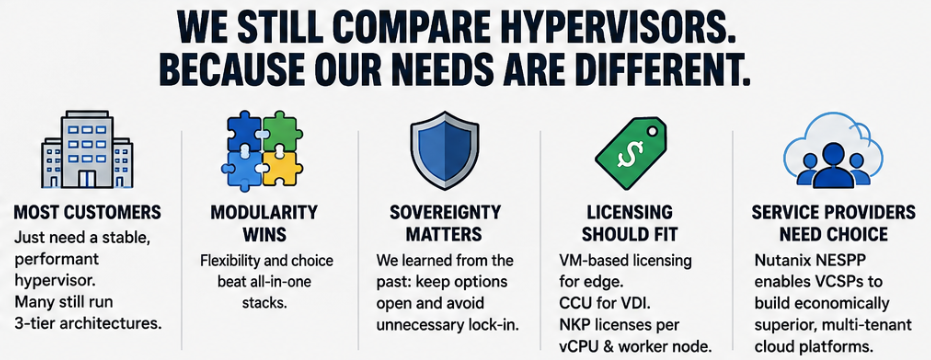
The reality in many data centers looks very different from the vision that vendors present on stage. Most organizations do not necessarily need a fully integrated cloud operating platform and they do not require every component of VMware Cloud Foundation (VCF), nor do they intend to consume the entire stack.
Many simply need a stable, secure, and performant virtualization platform.
They need a platform that reliably runs their business applications, integrates with their existing operational processes and supports the storage and networking architectures they have already invested in. In many enterprises, particularly in regulated industries and the public sector, traditional three-tier architectures remain highly relevant. Large investments in external storage platforms, backup solutions, and networking infrastructure are not replaced overnight simply because a vendor changes its strategic narrative. But yes, VCF and other platforms could co-exist and integrate.
Anyway, the market reality is therefore much more diverse than the messaging sometimes suggests.
Over the past decade, the industry experienced a strong trend towards hyperconverged infrastructure (HCI). Why? Because HCI promised operational simplicity and an integrated experience, and for many organizations, it delivered exactly that.
At the same time, something else happened. In my opinion, the most successful infrastructure platforms and VMware alternatives today are often those that offer choice, modularity and flexibility.
Customers increasingly want the ability to adopt only the components they need – they want to decide whether they run hyperconverged storage or external storage (or both). They want to choose between different Kubernetes platforms, networking solutions, or operational models, and they want the freedom to evolve their architecture gradually rather than committing to a full platform adoption approach.
In many ways, the market is rediscovering the value of optionality.
The Sovereignty Lesson
There is another dimension that has fundamentally changed the way customers think about infrastructure platforms. Yes, sovereignty.
For years, infrastructure decisions were primarily driven by technical capabilities, operational efficiency and cost. The Broadcom acquisition of VMware has added a new consideration to the equation. It has reminded many organizations that technical dependencies eventually become commercial dependencies as well.
The past two years have been an eye-opening experience for many customers. Organizations that considered themselves highly mature and technologically independent suddenly realized how difficult it can be to move away from a platform that has become deeply embedded in their operations. Licensing changes, product packaging and new commercial models have forced many IT leaders to ask uncomfortable but important questions about flexibility, choice and long-term strategic control.
I am not saying that vendor lock-in is inherently bad.
Every infrastructure decision creates dependencies. Choosing a cloud provider, a storage platform, a Kubernetes distribution or even an operating system introduces some degree of lock-in. The important distinction is whether these dependencies are intentional or not.
Customers increasingly want to understand which dependencies they are accepting and why. They want to preserve the ability to adapt, evolve and, if necessary, change direction in the future. Sovereignty, in this context, is less about achieving complete independence – which is almost impossible in modern IT – and more about maintaining optionality.
The market is therefore moving towards architectures that provide greater flexibility and reduce unnecessary constraints.
This is one of the reasons modularity has become such an important topic in the private cloud market. Organizations are increasingly favoring platforms that allow them to consume only the components they need and to integrate with technologies they already own and trust.
Nutanix has been moving steadily in this direction.
While the company built its success around HCI, its strategy today is increasingly focused on providing choice. For more than a year, Nutanix has supported external storage integrations, enabling customers to preserve existing investments and design architectures that fit their operational requirements rather than forcing them into a predefined model.
The company continues to expand this ecosystem through additional partnerships and integrations, with further announcements expected throughout 2027. Perhaps the most significant milestone is the upcoming general availability of NetApp integration later this year. For many enterprises that have heavily invested in NetApp over the past decade, this represents an important step towards greater architectural flexibility and investment protection.
The same philosophy extends into the service provider market.
Through the Nutanix Elevate Service Provider Program (NESPP), Nutanix offers an alternative for existing VMware Cloud Service Providers (VCSP) that are (still) reassessing their long-term strategy. By combining the Nutanix platform with a multi-tenant layer designed specifically for service providers, Nutanix enables partners to build cloud platforms that are often economically more attractive while maintaining a high degree of operational flexibility and independence.
Ultimately, the lesson many organizations have taken from the VMware acquisition is not that lock-in should be avoided at all costs. Such a goal is unrealistic. Again, the lesson is that dependencies should be intentional.
Customers should consciously decide where they want to standardize, where they are willing to commit to a vendor, and where they want to preserve optionality. The ability to move, or at least the possibility of moving, has become a strategic capability in itself.
And that may well become one of the defining characteristics of sovereign infrastructure in the years ahead.
Licensing Models Matter Too
Comparing hypervisors is not only about technical capabilities, but also about commercial models.
One of the lessons many organizations have learned over the past two years is that licensing metrics can have a significant impact on long-term economics and architectural flexibility. A platform may be technically sound, but if its commercial model does not align with the way a customer consumes infrastructure, it can quickly become difficult to justify. This is another reason why hypervisor comparisons remain relevant.
Different vendors increasingly offer different licensing approaches that can be better suited for specific use cases. Nutanix, for example, does not exclusively rely on a per-core licensing model. For edge deployments, the company licenses its platform based on the number of virtual machines. For virtual desktop environments, licensing can be based on concurrent users through a CCU model.
For customers running hundreds or even thousands of virtual desktops, or operating large numbers of small edge locations, these models can provide a significantly fairer and more predictable economic framework than licensing purely based on CPU cores.
The same philosophy can be seen in the Kubernetes space.
Nutanix Kubernetes Platform (NKP) does not require customers to commit to an entire infrastructure stack from day one. Organizations can start small, deploy NKP on existing or dedicated infrastructure, and license the platform based only on the vCPUs and worker nodes (even baremetal) they actually consume.
This allows customers to gradually build their cloud-native capabilities without first having to adopt or license an entire private cloud platform.
In many ways, licensing has become another dimension of (economic) sovereignty.
Technical flexibility without commercial flexibility is only half the story. Customers increasingly want the ability to scale incrementally, adopt new technologies selectively and align commercial models with actual consumption patterns.
This is precisely where modularity an economic and strategic capability.
And ultimately, this is also why comparing hypervisors, and the licensing models that come with them, remains a perfectly valid exercise, even in a world where virtualization itself is increasingly considered a commodity.
VMware vSphere Foundation “is back”?
Perhaps the most interesting development over the past two years is that the market itself has pushed back against some of the industry’s narratives.
Broadcom has repeatedly positioned VCF as the strategic destination and has encouraged customers to think in terms of complete cloud platforms rather than individual infrastructure components. Yet reality has proven to be more nuanced.
The reintroduction of VMware vSphere Foundation (VVF) in several regions where it had previously become unavailable suggests that a significant part of the market still demands simpler and more modular consumption models. If every customer truly wanted or needed the entire VCF stack, there would have been little reason to bring additional options back to the portfolio.
Broadcom presents this as increased flexibility and customer choice. At the same time, many customers observe that the pricing model makes VCF the economically more attractive option, while VVF has become comparatively more expensive (apparently it went from $135 to $190 list price) and, in certain scenarios, financially less appealing (because of higher discounts for VCF). As a result, the decision to adopt VCF is often driven by commercial considerations rather than by a genuine desire to consume every component/feature of the platform.
Seeing strong adoption of VCF subscriptions does not necessarily mean that customers have embraced the complete VMware Cloud Foundation vision. In many cases, organizations continue to operate largely decoupled environments with external storage, traditional networking architectures and established operational models. The subscription may have changed, but the architecture often has not.
VMware is right that the industry is moving towards platforms and cloud operating models. However, the market is equally clear in communicating that not every organization is ready (or willing) to consume an integrated stack in its entirety.
So, Does Comparing Hypervisors Still Matter?
Even if virtualization itself has become something of a commodity, the hypervisor is still the foundation upon which every private cloud strategy is built. It still has implications for licensing, operational complexity, ecosystem integration, skills requirements and long-term flexibility.
For many organizations, the question is not which complete cloud stack they want to buy, but rather which virtualization platform best aligns with their existing architecture and future ambitions. Some organizations are ready to embrace fully integrated cloud platforms and consume as many services as possible from a single vendor. Others choose a more modular approach, assembling their own private cloud architecture from best-of-breed components.
Both approaches are valid.
VMware is correct in saying that infrastructure discussions should increasingly focus on cloud operating models rather than individual hypervisor features. But customers are equally justified when they continue to compare hypervisors, especially if their operational requirements are centered around virtualization rather than the consumption of an entire cloud stack.
The hypervisor may no longer be the most exciting component of the data center, but it remains one of the most important architectural decisions an organization makes.
Comparing hypervisors is therefore not outdated. It is simply a recognition that, despite all the talk about cloud platforms and integrated stacks, many enterprises still value flexibility, modularity and the freedom to build infrastructure on their own terms.
The hypervisor may have become a commodity, choice has not.