Stop Writing About VMware vs. Nutanix

Stop Writing About VMware vs. Nutanix

Over the last months I have noticed something “interesting”. My LinkedIn feed and Google searches are full of posts and blogs that try to compare VMware and Nutanix. Most of them follow the same pattern. They take the obvious features, line them up in two columns, and declare a “winner”. Some even let AI write these comparisons without a single line of lived experience behind it.

The problem? This type of content has no real value for anyone who has actually run these platforms in production. It reduces years of engineering effort, architectural depth, and customer-specific context into a shallow bullet list. Worse, it creates the illusion that such a side-by-side comparison could ever answer the strategic question of “what should I run my business on?”.

The Wrong Question

VMware vs. Nutanix is the wrong question to ask. Both vendors have their advantages, both have strong technology stacks, and both have long histories in enterprise IT. But if you are an IT leader in 2025, your real challenge is not to pick between two virtualization platforms. Your challenge is to define what your infrastructure should enable in the next decade.

Do you need more sovereignty and independence from hyperscalers? Do you need a platform that scales horizontally across the edge, data center, and public cloud with a consistent operating model? Do you need to keep costs predictable and avoid the complexity tax that often comes with layered products and licensing schemes?

Those are the real questions. None of them can be answered by a generic VMware vs. Nutanix LinkedIn post.

The Context Matters

A defense organization in Europe has different requirements than a SaaS startup in Silicon Valley. A government ministry evaluates sovereignty, compliance, and vendor control differently than a commercial bank that cares most about performance and transaction throughput.

The context (regulatory, organizational, and strategic) always matters more than product comparison charts. If someone claims otherwise, they probably have not spent enough time in the field, working with CIOs and architects who wrestle with these issues every day. Yes, (some) features are important and sometimes make the difference, but the big feature war days are over.

It’s About the Partner, Not Just the Platform

At the end of the day, the platform is only one piece of the puzzle. The bigger question is: who do you want as your partner for the next decade?

Technology shifts, products evolve, and roadmaps change. What remains constant is the relationship you build with the vendor or partner behind the platform. Can you trust them to execute your strategy with you? Can you rely on them when things go wrong? Do they share your vision for sovereignty, resilience, and simplicity or are they simply pushing their own agenda?

The answer to these questions matters far more than whether VMware or Nutanix has the upper hand in a feature battle.

A Better Conversation

Instead of writing another VMware vs. Nutanix blog, we should start a different conversation. One that focuses on operating models, trust, innovation, ecosystem integration, and how future-proof your platform is.

Nutanix, VMware, Red Hat, hyperscalers, all of them are building infrastructure and cloud stacks. The differentiator is not whether vendor A has a slightly faster vMotion or vendor B has one more checkbox in the feature matrix. The differentiator is how these platforms align with your strategy, your people, and your risk appetite, and whether you believe the partner behind it is one you can depend on.

Why This Matters Now

The market is in motion. VMware customers are forced to reconsider their roadmap due to the Broadcom acquisition and the associated licensing changes. Nutanix is positioning itself as a sovereign alternative with strong hybrid cloud credentials. Hyperscalers are pushing local zones and sovereign cloud initiatives.

In such a market, chasing simplistic comparisons is a waste of time. Enterprises should focus on long-term alignment with their cloud and data strategy. They should invest in platforms and partners that give them control, choice, and agility.

Final Thought

So let’s stop writing useless VMware vs. Nutanix comparisons. They don’t help anyone who actually has to make decisions at scale. Let’s raise the bar and bring back thought leadership to this industry. Share real experiences. Talk about strategy and outcomes. Show where platforms fit into the bigger picture of sovereignty, resilience, and execution. And most importantly: choose the partner you can trust to walk this path with you.

That is the conversation worth having. Everything else is just noise and bullshit.
Finally, People Start Realizing Sovereignty Is a Spectrum

Finally, People Start Realizing Sovereignty Is a Spectrum

For months and years, the discussion about cloud and digital sovereignty has been dominated by absolutes. It was framed as a black-and-white choice. Either you are sovereign, or you are not. Either you trust hyperscalers, or you don’t. Either you build everything yourself, or you hand it all over. But over the past two years, organizations, governments, and even the vendors themselves have started to recognize that this way of thinking doesn’t reflect reality. Sovereignty is seen as a spectrum now.

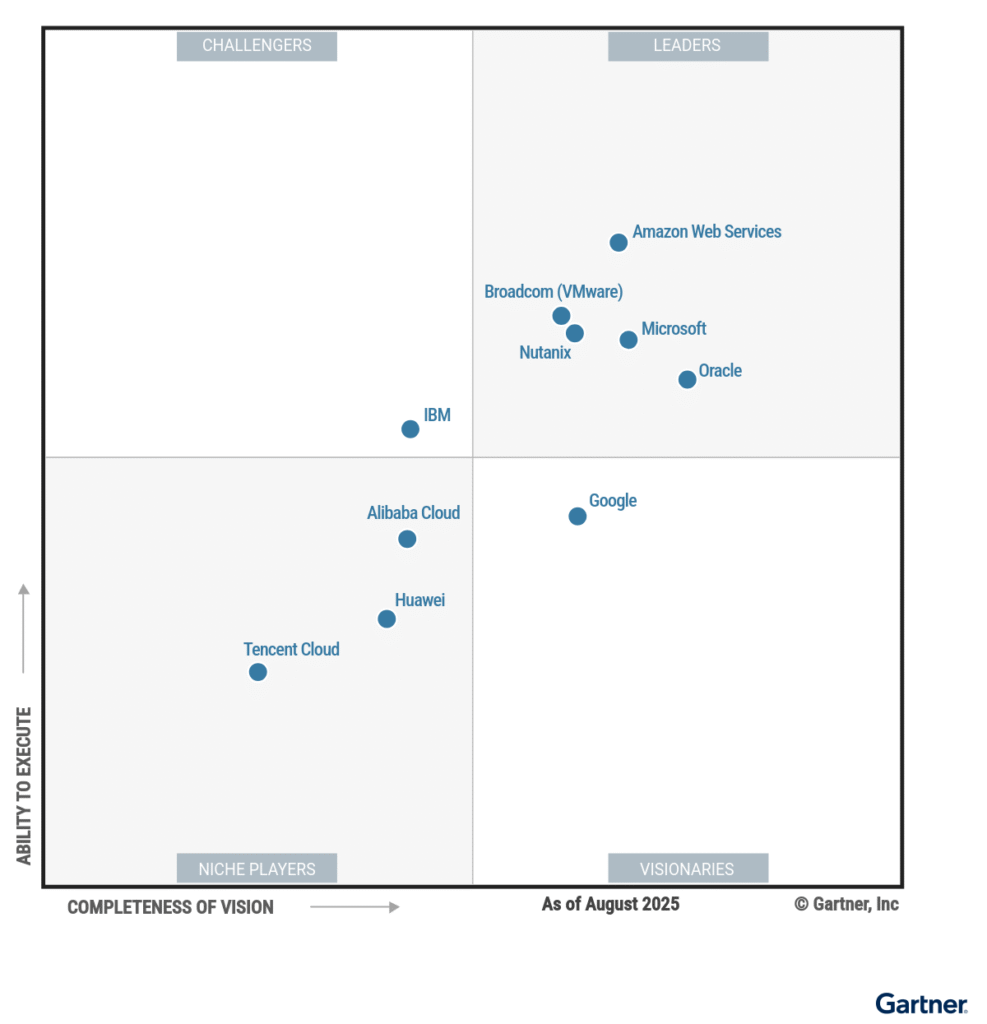
When I look at the latest Gartner Magic Quadrant (MQ) for Distributed Hybrid Infrastructure (DHI), this shift becomes even more visible. In the leader’s quadrant, we find AWS, Microsoft, Oracle, Broadcom (VMware), and Nutanix. Each of them is positioned differently, but they all share one thing in common. They now operate somewhere along this sovereignty spectrum. Some of them are “fully” sovereign and some of them are dependent. The truth lies in between, and it is about how much control you want to retain versus how much you are willing to outsource. But it’s also possible to have multiple vendors and solutions co-existing.

Gartner MQ DHI 2025

The Bandwidth of Sovereignty

To make this shift more tangible, think of sovereignty as a bandwidth rather than a single point. On the far left, you give up almost all control and rely fully on global hyperscalers, following their rules, jurisdictions, and technical standards. On the far right, you own and operate everything in your data center, with full control but also full responsibility. Most organizations today are somewhere in between (using a mix of different vendors and clouds).

This bandwidth allows us to rate the leaders in the MQ not as sovereign or non-sovereign, but according to where they sit on the spectrum:

  • AWS stretches furthest toward global reach and scalability. They are still in the process of building a sovereign cloud, and until that becomes reality, none of their extensions (Outposts, Wavelength, Local Zones) can truly be seen as sovereign (please correct me if I am wrong). Their new Dedicated Local Zones bring infrastructure closer, but AWS continues to run the show. Meaning sovereignty is framed through compliance, not operational autonomy.

  • Microsoft sits closer to the middle. With Microsoft’s Sovereign Cloud initiatives in Europe, they acknowledge the political and regulatory reality. Customers gain some control over data residency and compliance, but the operational steering remains with Microsoft (except for their “Sovereign Private Cloud” offering, which consists of Azure Local + Microsoft 365 Local).

  • Oracle has its EU Sovereign Cloud, which is already available today, and with offerings like OCI Dedicated Region and Alloy that push sovereignty closer to customers. Still, these don’t offer operational autonomy, as Oracle continues to manage much of the infrastructure. For full isolation, Oracle provides Oracle Cloud Isolated Region and the smaller Oracle Compute Cloud@Customer Isolated (C3I). These are unique in the hyperscaler landscape and move Oracle further to the right.

  • Broadcom (VMware) operates in a different zone of the spectrum. With VMware’s Cloud Foundation stack, customers can indeed build sovereign clouds with operational autonomy in their own data centers. This puts them further right than most hyperscalers. But Gartner and recent market realities also show that dependency risks are not exclusive to AWS or Azure. VMware customers face uncertainty tied to Broadcom’s licensing models and strategic direction, which balances out their autonomy.

  • Google does not appear in the leader’s quadrant yet, but their Google Distributed Cloud (GDC) deserves mention. Gartner highlights how GDC is strategically advancing, winning sovereign cloud projects with governments and partners, and embedding AI capabilities on-premises. Their trajectory is promising, even if their current market standing hasn’t brought them into the top right yet.

  • Nutanix stands out by offering a comprehensive single product – the Nutanix Cloud Platform (NCP). Gartner underlines that NCP is particularly suited for sovereign workloads, hybrid infrastructure management, and edge multi-cloud deployments. Unlike most hyperscalers, Nutanix delivers one unified stack, including its “own hypervisor as a credible ESXi alternative”. That makes it possible to run a fully sovereign private cloud with operational autonomy, without sacrificing cloud-like agility and elasticity.

Why the Spectrum Matters

This sovereignty spectrum changes how CIOs and policymakers make decisions. Instead of asking “Am I sovereign or not?”, the real question becomes:

How far along the spectrum do I want to be and how much am I willing to compromise for flexibility, cost, or innovation?

It is no longer about right or wrong. Choosing AWS does not make you naive. Choosing Nutanix does not make you paranoid. Choosing Oracle does not make you old-fashioned. Choosing Microsoft doesn’t make you a criminal. Each decision reflects an organization’s position along the bandwidth, balancing risk, trust, cost, and control.

Where We Go From Here

The shift to this spectrum-based view has major consequences. Vendors will increasingly market not only their technology but also their place on the sovereignty bandwidth. Governments will stop asking for absolute sovereignty and instead demand clarity about where along the spectrum a solution sits. And organizations will begin to treat sovereignty not as a one-time decision but as a dynamic posture that can move left or right over time, depending on regulation, innovation, and geopolitical context.

The Gartner MQ shows that the leaders are already converging around this reality. The differentiation now lies in how transparent they are about it and how much choice they give their customers to slide along the spectrum. Sovereignty, in the end, is not a fixed state. It is a journey.