Why Emulating the Cloud Isn’t the Same as Being One

Why Emulating the Cloud Isn’t the Same as Being One

It’s easy to mistake progress for innovation. VMware Cloud Foundation 9.0 (VCF) introduces long-awaited features like VPC-style networking, developer-centric automation, and bundled services. But let’s be honest: this is not the future of cloud. This is infrastructure catching up to where the public cloud world already was ten years ago.

Example: Moving some concepts and features from VMware Cloud Director (vCD) to Aria Automation and then calling it VCF Automation is also not innovative. It was the right thing to do, as vCD and Aria Automation (formerly known as vRealize Automation) shared many overlapping features and concepts. In other words, we can expect VCF Automation to be the future and vCD will be retired in a few years.

Anyway, there’s a pattern here. Platform vendors continue to position themselves as “private cloud providers”, yet the experience they offer remains rooted in managing hardware, scaling clusters, and applying patches. Whether it’s VCF or Nutanix, the story is always the same: it’s better infrastructure. But that’s the problem. It’s still infrastructure.

In contrast, the real shift toward cloud doesn’t start with software-defined storage or NSX overlay networks. It starts with the service model. That’s what makes cloud work. That’s what makes it scalable, elastic, and developer-first. That’s what customers actually need.

Let’s unpack where VCF 9.0 lands and why it still misses the mark.

What’s New in VCF 9.0. And What’s Not.

Broadcom deserves credit for moving VCF closer to what customers have been asking for since at least 2020. The platform now includes a proper developer consumption layer, integrated VPC-style networking, a simplified control plane, and aligned software versions for different products. Yes, it feels more like a cloud. It automates more, hides more complexity, and makes day 2 operations less painful. All good steps!

The new virtual private cloud constructs let teams carve out self-contained network domains – complete with subnets, NAT, firewall rules, and load balancers – all provisioned from a central interface. That’s a meaningful upgrade from the old NSX workflows. Now, transit gateways can be deployed automatically, reducing the friction of multi-domain connectivity. The whole setup is better, simpler, and more cloud-like. Well done.

On the consumption side, there’s a proper push toward unified APIs. Terraform support, policy-as-code blueprints in YAML, and native Kubernetes provisioning give developers a way to consume infrastructure more like they would in a hyperscaler environment. VCF customers can onboard teams faster, and the lifecycle engine behind the scenes handles upgrades, certificates, and best-practice configurations with far less manual effort.

So yes, VCF 9.0 is a big step forward for Broadcom and for existing VMware customers. But let’s put that progress into perspective.

Cloud Features Delivered Years Too Late

The features we’re seeing now – developer APIs, VPCs, self-service provisioning, built-in security, elastic-like networking – these aren’t breakthroughs. They are basic expectations. Public cloud providers like AWS and Azure introduced the VPC concept more than 10 years ago. Public clouds have offered full-stack policy automation, service mesh observability, and integrated load balancing for most of the last decade.

What VCF 9.0 delivers in 2025 is essentially what existing on-premises customers were asking for back in 2020.

The bigger concern is that VMware has always been the benchmark for enterprise-grade virtualization and private infrastructure. When customers bought into VCF years ago, they expected these capabilities then, not now. Broadcom has simply shipped the version of VCF that many customers assumed was already on the roadmap, five years ago.

And even now, many of the services (add-ons) in VCF 9.0 like Avi load balancing, vDefend IDS/IPS, integrated databases, and AI services, are optional components, mostly manually deployed, and not fully elastic or usage-based. These are integrations, not native services. You still need to operate them.

The Core Problem: It’s Still Infrastructure-Led

That’s the real difference. VCF and Nutanix remain infrastructure-led platforms. They require hardware planning, capacity management, lifecycle orchestration, and dependency tracking. Yes, they have APIs. Yes, they support Kubernetes. But at their core, they are platforms you need to own, operate, and scale yourself.

Cloud, on the other hand, is not about owning anything. It’s about consuming outcomes. VCF 9.0 and others are just not there yet.

The Illusion of a Private Cloud

This is why it’s time to call out the difference. Just because something looks like cloud – has some APIs, supports Kubernetes, uses words like “consumption” and “developer self-service” – doesn’t mean it actually behaves like cloud.

The illusion of a “private cloud” is seductive. You get to keep control. You get to use familiar tools. But control also means responsibility. Familiar tools mean legacy thinking. And a so-called private cloud, in most cases, just means more complex infrastructure with higher expectations.

That’s not transformation. That’s rebranding.

What VCF 9.0 delivers is an important evolution of VMware’s private infrastructure platform. But let’s not confuse that with cloud. Broadcom has moved in the right direction. They have shipped what customers needed years ago. But they are still delivering (virtual) infrastructure. Just better packaged.

Final Thought

You don’t transform your IT strategy by modernizing clusters. You transform it by changing how you consume and operate technology.

So the question isn’t whether your stack looks like “the cloud”. The question is whether you can stop operating infrastructure and start consuming services.

That’s the real line between emulating the cloud and actually being one. And as of today, VCF (and Nutanix) are still on the other side of that line. It’s not good. It’s not bad. It is what it is.

The State of Application Modernization 2025

The State of Application Modernization 2025

Every few weeks, I find myself in a conversation with customers or colleagues where the topic of application modernization comes up. Everyone agrees that modernization is more important than ever. The pressure to move faster, build more resilient systems, and increase operational efficiency is not going away.

But at the same time, when you look at what has actually changed since 2020… it is surprising how much has not.

We are still talking about the same problems: legacy dependencies, unclear ownership, lack of platform strategy, organizational silos. New technologies have emerged, sure. AI is everywhere, platforms have matured, and cloud-native patterns are no longer new. And yet, many companies have not even started building the kind of modern on-premises or cloud platforms needed to support next-generation applications.

It is like we are stuck between understanding why we need to modernize and actually being able to do it.

Remind me, why do we need to modernize?

When I joined Oracle in October 2024, some people reminded me that most of us do not know why we are where we are. One could say that it is not important to know that. In my opinion, it very much is. Something has fundamentally changed in the past that has led us to our situation.

In the past, when we moved from physical servers to virtual machines (VMs), apps did not need to change. You could lift and shift a legacy app from bare metal to a VM and it would still run the same way. The platform changed, but the application did not care. It was an infrastructure-level transformation without rethinking the app itself. So, the transition (P2V) of an application was very smooth and not complicated.

But now? The platform demands change.

Cloud-native platforms like Kubernetes, serverless runtimes, or even fully managed cloud services do not just offer a new home. They offer a whole new way of doing things. To benefit from them, you often have to re-architect how your application is built and deployed.

That is the reason why enterprises have to modernize their applications.

What else is different?

User expectations, business needs, and competitive pressure have exploded as well. Companies need to:

  • Ship features faster
  • Scale globally
  • Handle variable load
  • Respond to security threats instantly
  • Reduce operational overhead

A Quick Analogy

Think of it like this: moving from physical servers to VMs was like transferring your VHS tapes to DVDs. Same content, just a better format.

But app modernization? That is like going from DVDs to Netflix. You do not just change the format, but you rethink the whole delivery model, the user experience, the business model, and the infrastructure behind it.

Why Is Modernization So Hard?

If application modernization is so powerful, why is not everyone done with it already? The truth is, it is complex, disruptive, and deeply intertwined with how a business operates. Organizations often underestimate how much effort it takes to replatform systems that have evolved over decades. Here are 6 common challenges companies face during modernization:

  1. Legacy Complexity – Many existing systems are tightly coupled, poorly documented, and full of business logic buried deep in spaghetti code. 
  2. Skill Gaps – Moving to cloud-native tech like Kubernetes, microservices, or DevOps pipelines requires skills many organizations do not have in-house. Upskilling or hiring takes time and money.
  3. Cultural Resistance – Modernization often challenges organizational norms, team structures, and approval processes. People do not always welcome change, especially if it threatens familiar workflows.
  4. Data Migration & Integration – Legacy apps are often tied to on-prem databases or batch-driven data flows. Migrating that data without downtime is a massive undertaking.
  5. Security & Compliance Risks – Introducing new tech stacks can create blind spots or security gaps. Modernizing without violating regulatory requirements is a balancing act.
  6. Cost Overruns – It is easy to start a cloud migration or container rollout only to realize the costs (cloud bills, consultants, delays) are far higher than expected.

Modernization is not just a technical migration. It’s a transformation of people, process, and platform (technology). That is why it is hard and why doing it well is such a competitive advantage!

Technical Debt Is Also Slowing Things Down

Also known as the silent killer of velocity and innovation: technical debt

Technical debt is the cost of choosing a quick solution now instead of a better one that would take longer. We have all seen/done it. 🙂 Sometimes it is intentional (you needed to hit a deadline), sometimes it is unintentional (you did not know better back then). Either way, it is a trade-off. And just like financial debt, it accrues interest over time.

Here is the tricky part: technical debt usually doesn’t hurt you right away. You ship the feature. The app runs. Management is happy.

But over time, debt compounds:

  • New features take longer because the system is harder to change

  • Bugs increase because no one understands the code

  • Every change becomes risky because there is no test safety net

Eventually, you hit a wall where your team is spending more time working around the system than building within it. That is when people start whispering: “Maybe we need to rewrite it.”  Or they just leave your company.

Let me say it: Cloud Can Also Introduce New Debt

Cloud-native architectures can reduce technical debt, but only if used thoughtfully.

You can still:

  • Over-complicate microservices

  • Abuse Kubernetes without understanding it

  • Ignore costs and create “cost debt”

  • Rely on too many services and lose track

Use the cloud to eliminate debt by simplifying, automating, and replacing legacy patterns, not just lifting them into someone else’s data center.

It Is More Than Just Moving to the Cloud 

Modernization is about upgrading how your applications are built, deployed, run, and evolved, so they are faster, cheaper, safer, and easier to change. Here are some core areas where I saw organizations are making real progress:

  • Improving CI/CD. You can’t build modern applications if your delivery process is stuck in 2010.
  • Data Modernization. Migrate from monolithic databases to cloud-native, distributed ones.
  • Automation & Infrastructure as Code. It is the path to resilience and scale.
  • Serverless Computing. It is the “don’t worry about servers” mindset and ideal for many modern workloads.
  • Containerizing Workloads. Containers are a stepping stone to microservices, Kubernetes, and real DevOps maturity.
  • Zero-Trust Security & Cybersecurity Posture. One of the biggest priorities at the moment.
  • Cloud Migration. It is not about where your apps run. it is about how well they run there. “The cloud” should make you faster, safer, and leaner.

As you can see, application modernization is not one thing, it’s many things. You do not have to do all of these at once. But if you are serious about modernizing, these points (any more) must be part of your blueprint. Modernization is a mindset.

Why (replatforming) now?

There are a few reasons why application modernization projects are increasing:

  • The maturity of cloud-native platforms: Kubernetes, managed databases, and serverless frameworks have matured to the point where they can handle serious production workloads. It is no longer “bleeding edge”
  • DevOps and Platform Engineering are mainstream: We have shifted from siloed teams to collaborative, continuous delivery models. But that only works if your platform supports it.
  • AI and automation demand modern infrastructure: To leverage modern AI tools, event-driven data, and real-time analytics, your backend can’t be a 2004-era database with a web front-end duct-taped to it.

Conclusion

There is no longer much debate: (modern) applications are more important than ever. Yet despite all the talk around cloud-native technologies and modern architectures, the truth is that many organizations are still trying to catch up and work hard to modernize not just their applications, but also the infrastructure and processes that support them.

The current progress is encouraging, and many companies have learned from the experience of their first modernization projects.

One thing that is becoming harder to ignore is how much the geopolitical situation is starting to shape decisions around application modernization and cloud adoption. Concerns around data sovereignty, digital borders, national cloud regulations, and supply chain security are no longer just legal or compliance issues. They are shaping architecture choices.

Some organizations are rethinking their cloud and modernization strategies, looking at multi-cloud or hybrid models to mitigate risk. Others are delaying cloud adoption due to regional uncertainty, while a few are doubling down on local infrastructure to retain control. It is not just about performance or cost anymore, but also about resilience and autonomy.

The global context (suddenly) matters, and it is influencing how platforms are built, where data lives, and who organizations choose to partner with. If anything, it makes the case even stronger for flexible, portable, cloud-native architectures. So you are not locked into a single region or provider.

From Cloud-First to Cloud-Smart to Repatriation

From Cloud-First to Cloud-Smart to Repatriation

VMware Explore 2024 happened this week in Las Vegas. I think many people were curious about what Hock Tan, CEO of Broadcom, had to say during the general session. He delivered interesting statements and let everyone in the audience know that “the future of enterprise is private – private cloud, private AI, fueled by your own private data“. On social media, the following slide about “repatriation” made quite some noise:

VMware Explore 2024 Keynote Repatriation

The information on this slide came from Barcley’s CIO Survey in April 2024 and it says that 8 out of 10 CIOs today are planning to move workloads from the public cloud back to their on-premises data centers. It is interesting, and in some cases even funny, that other vendors in the hardware and virtualization business are chasing this ambulance now. Cloud migrations are dead, let us do reverse cloud migrations now. Hybrid cloud is dead, let us do hybrid multi-clouds now and provide workload mobility. My social media walls are full of such postings now. It seems Hock Tan presented the Holy Grail to the world.

Where is this change of mind from? Why did only 43% during COVID-19 plan a reverse cloud migration and now “suddenly” more than 80%?

I could tell you the story now about cloud-first not being cool anymore, that organizations started to follow a smarter cloud approach, and then concluded that cloud migrations are still not happening based on their expectations (e.g., costs and complexity). And that it is time now to bring workloads back on-premises. It is not that simple.

I looked at Barclay’s CIO survey and the chart (figure 20 in the survey) that served as a source for Hock Tan’s slide:

Barclays CIO Survey April 2024 Cloud RepatriationWe must be very careful with our interpretation of the results. Just because someone is “planning” a reverse cloud migration, does it mean they are executing? And if they execute such an exercise, is this going to be correctly reflected in a future survey?

And which are the workloads and services that are brought back to an enterprise’s data center? Are we talking about complete applications? Or is it more about load balancers, security appliances, databases and storage, and specific virtual machines? And if we understand the workloads, what are the real reasons to bring them back? Figure 22 of the survey shows “Workloads that Respondents Intend to Move Back to Private Cloud / On-Premise from Public Cloud”:

Barclays CIO Survey April 2024 Workload to migrate

Okay, we have a little bit more context now. Just because some workloads are potentially migrated back to private clouds, what does it mean for public cloud vs. private cloud spend? Question #11 of the survey “What percentage of your workloads and what percentage of your total IT spend are going towards the public cloud, and how have those evolved over time?” focuses on this matter.

Barclays CIO Survey April 2024 Percentage of Workloads and Spend My interpretation? Just because one slide or illustration talks about repatriation does not mean, that the entire world is just doing reverse migrations now. Cloud migrations and reverse cloud migrations can happen at the same time. You could bring one application or some databases back on-premises but decide to move all your virtual desktops to the public cloud in parallel. We could still bring workloads back to our data center and increase public cloud spend. 

Sounds like cloud-smart again, doesn’t it? Maybe I am an organization that realized that the applications A, B, C, and D shouldn’t run in Azure, AWS, Google, and Oracle anymore, but the applications W, X, Y, and Z are better suited for these hyperscalers.

What else?

I am writing about my views and my opinions here. There is more to share. During the pandemic, everything had to happen very quickly, and everyone suddenly had money to speed up migrations and application modernization projects. After that, I think it is a natural thing that everything was slowing down a bit after this difficult and exhausting phase.

Some of the IT teams are probably still documenting all their changes and new deployments on an internal wiki, and their bosses started to hire FinOps specialists to analyze their cloud spend. It is no shocking surprise to me that some of the financial goals haven’t been met and result in a reverse cloud migration a few years later.
But that is not all. Try to think about the past years. What else happened?

Yes, we almost forgot about Artificial Intelligence (AI) and Sovereign Clouds.

Before 2020, not many of us were thinking about sovereign clouds, data privacy, and AI.

Most enterprises are still hosting their data on-premises behind their own firewall. And some of this data is used to train or finetune models. We see (internal) chatbots popping up using Retrieval Augmented Generation (RAG), which delivers answers based on actual data and proprietary information.

Okay. What else? 

Yep, there is more. There are new technologies and offerings available that were not here before. We just covered AI and ML (machine learning) workloads that became a potential cost or compliance concern.

The concept of sovereign clouds has gained traction due to increasing concerns about data sovereignty and compliance with local regulations.

The adoption of hybrid and hybrid multi-cloud strategies has been a significant trend from 2020 to 2024. Think about VMware’s Cloud Foundation approach with Azure, Google, Oracle etc., AWS Outposts, Azure Stack, Oracle’s DRCC, or Nutanix’s.

Enterprises started to upskill and train their people to deliver their own Kubernetes platforms.

Edge computing has emerged as a crucial technology, particularly for industries like manufacturing, telecommunications, and healthcare, where real-time data processing is critical.

Conclusion

Reverse cloud migrations are happening for many different reasons like cost management, performance optimization, data security and compliance, automation and operations, or because of lock-in concerns.

Yes, (cloud) repatriation became prominent, but I think this is just a reflection of the maturing cloud market – and not an ambulance.

And no, it is not a better moment to position your hybrid multi-cloud solutions, unless you understand the services and workloads that need to be migrated from one cloud to another. Just because some CIOs plan to bring back some workloads on-premises, does it mean/imply that they will do it? What about the sunk cost fallacy?

Perhaps IT leaders are going to be more careful in the future and are trying to find other ways for potential cost savings and strategic benefits to achieve their business outcomes – and keep their workloads in the cloud versus repatriating them.

Businesses are adopting a more nuanced workload-centric strategy.

What’s your opinion?

Distributed Hybrid Infrastructure Offerings Are The New Multi-Cloud

Distributed Hybrid Infrastructure Offerings Are The New Multi-Cloud

Since VMware belongs to Broadcom, there was less focus and messaging on multi-cloud or supercloud architectures. Broadcom has drastically changed the available offerings and VMware Cloud Foundation is becoming the new vSphere. Additionally, we have seen big changes regarding the partnerships with hyperscalers (the Azures and AWSes of this world) and the VMware Cloud partners and providers. So, what happened to multi-cloud and how come that nobody (at Broadcom) talks about it anymore?

What is going on?

I do not know if it’s only me, but I do not see the term “multi-cloud” that often anymore. Do you? My LinkedIn feed is full of news about artificial intelligence (AI) and how Nvidia employees got rich. So, I have to admit that I lost track of hybrid clouds, multi-clouds, or hybrid multi-cloud architectures. 

Cloud-Inspired and Cloud-Native Private Clouds

It seems to me that the initial idea of multi-cloud has changed in the meantime and that private clouds are becoming platforms with features. Let me explain.

Organizations have built monolithic private clouds in their data centers for a long time. In software engineering, the word “monolithic” describes an application that consists of multiple components, which form something larger. To build data centers, we followed the same approach by using different components like compute, storage, and networking. And over time, IT teams started to think about automation and security, and the integration of different solutions from different vendors.

The VMware messaging was always pointing in the right direction: They want to provide a cloud operating system for any hardware and any cloud (by using VMware Cloud Foundation). On top of that, build abstraction layers and leverage a unified control plane (aka consistent automation and operations).

And I told all my customers since 2020 that they need to think like a cloud service provider, get rid of silos, implement new processes, and define a new operating model. That is VMware by Broadcom’s messaging today and this is where they and other vendors are headed: a platform with features that provide cloud services.

In other words, and this is my opinion, VMware Cloud Foundation is today a platform with different components like vSphere, vSAN, NSX, Aria, and so on. Tomorrow, it is still called VMware Cloud Foundation, a platform that includes compute, storage, networking, automation, operations, and other features. No more other product names, just capabilities, and services like IaaS, CaaS, DRaaS or DBaaS. You just choose the specs of the underlying hardware and networking, deploy your private clouds, and then start to build and consume your services.

Replace the name “VMware Cloud Foundation” in the last paragraph with AWS Outposts or Azure Stack. Do you see it now? Distributed unmanaged and managed hybrid cloud offerings with a (service) consumption interface on top.

That is the shift from monolithic data centers to cloud-native private clouds.

From Intercloud to Multi-Cloud

It is not the first time that I write about interclouds, that not many of us know. In 2012, there was this idea that different clouds and vendors need to be interoperable and agree on certain standards and protocols. Think about interconnected private and public clouds, which allow you to provide VM mobility or application portability. Can you see the picture in front of you? What is the difference today in 2024?

In 2023, I truly believed that VMware figured it out when they announced VMware Cloud on Equinix Metal (VMC-E). To me, VMC-E was different and special because of Equinix, who is capable of interconnecting different clouds, and at the same time could provide a baremetal-as-a-service (BMaaS) offering.

Workload Mobility and Application Portability

Almost 2 years ago, I started to write a book about this topic, because I wanted to figure out if workload mobility and application portability are things, that enterprises are really looking for. I interviewed many CIOs, CTOs, chief architects and engineers around the globe, and it became VERY clear: it seems nobody was changing anything to make app portability a design requirement.

Almost all of the people I have spoken to, told me, that a lot of things must happen that could trigger a cloud-exit and therefore they see this as a nice-to-have capability that helps them to move virtual machines or applications faster from one cloud to another.

VMware Workload Mobility

And I have also been told that a lift & shift approach is not providing any value to almost all of them.

But when I talked to developers and operations teams, the answers changed. Most of them did not know that a vendor could provide mobility or portability. Anyway, what has changed now?

Interconnected Multi-Clouds and Distributed Hybrid Clouds

I mentioned it already before. Some vendors have realized that they need to deliver a unified and integrated programmable platform with a control plane. Ideally, this control plane can be used on-premises, as a SaaS solution, or both. And according to Gartner, these are the leaders in this area (Magic Quadrant for Distributed Hybrid Infrastructure):

Gartner Magic-Quadrant-for-Distributed-Hybrid-Infrastructure

In my opinion, VMware and Nutanix are providing a hybrid multi-cloud approach.

AWS and Microsoft are providing hybrid cloud solutions. In Microsoft’s case, we see Azure Stack HCI, Azure Kubernetes Service (AKS incl. Hybrid AKS) and Azure Arc extending Microsoft’s Azure services to on-premises data centers and edge locations.

The only vendor, that currently offers true multi-cloud capabilities, is Oracle. Oracle has Dedicated Region Cloud@Customer (DRCC) and Roving Edge, but also partnerships with Microsoft and Google that allow customers to host Oracle databases in Azure and Google Cloud data centers. Both partnerships come with a cross-cloud interconnection.

That is one of the big differences and changes for me at the moment. Multi-cloud has become less about mobility or portability, a single global control plane, or the same Kubernetes distribution in all the clouds, but more about bringing different services from different cloud providers closer together.

This is the image I created for the VMC-E blog. Replace the words “AWS” and “Equinix” with “Oracle” and suddenly you have something that was not there before, an interconnected multi-cloud.

What’s Next?

Based on the conversations with my customers, it does not feel that public cloud migrations are happening faster than in 2020 or 2022 and we still see between 70 and 80% of the workloads hosted on-premises. While we see customers who are interested in a cloud-first approach, we see many following a hybrid multi-cloud and/or multi-cloud approach. It is still about putting the right applications in the right cloud based on the right decisions. This has not changed.

But the narrative of such conversations has changed. We will see more conversations about data residency, privacy, security, gravity, proximity, and regulatory requirements. Then there are sovereign clouds.

Lastly, enterprises are going to deploy new platforms for AI-based workloads. But that could still take a while.

Final Thoughts

As enterprises continue to navigate the above mentioned complexities, the need for flexible, scalable, and secure infrastructure solutions will only grow. There are a few compelling solutions that bridge the gap between traditional on-premises systems and modern cloud environments.

And since most enterprises are still hosting their workloads on-premises, they have to decide if they want to stretch the private cloud to the public cloud, or the other way around. Both options can co-exist, but would make it too big and too complex. What’s your conclusion?
VMware vSphere Foundation and VMware Cloud Foundation Overview

VMware vSphere Foundation and VMware Cloud Foundation Overview

As some of you already know, VMware by Broadcom is moving forward to primary offers only: VMware vSphere Foundation (VVF) and VMware Cloud Foundation (VCF). If you have missed this announcement, have a look at my blog A New Era: Broadcom’s Streamlined Approach to VMware’s Product Lineup and Licensing.

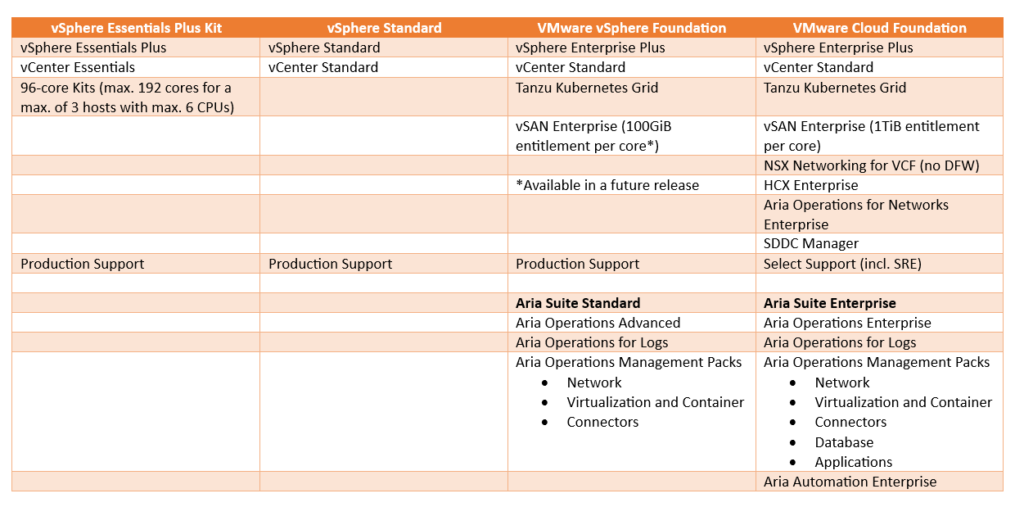
Since a lot of solutions and different editions from before are included, I thought it might be helpful to summarize in a little bit more detail what is known to partners, analysts, and some customers already. I am also adding some screenshots from VMware websites and presentations, which should help everyone get a better understanding of VVF and VCF.

vSphere Foundation and VMware Cloud Foundation

I have included the vSphere editions for smaller use cases and projects as well.

Please note that ROBO licenses are not available anymore and I expect the edge division at VMware by Broadcom to come up with additional bundles in the future.

VVF and VCF Products

More details about the different products and the features included in the Aria suites can be found here: VMware Aria Suite Editions and Products

If you are looking for more information about the Aria Operations management packs (formerly known as True Visibility Suite or Aria Operations for Integrations), have a look here: VMware Aria Operations for Integrations Documentation

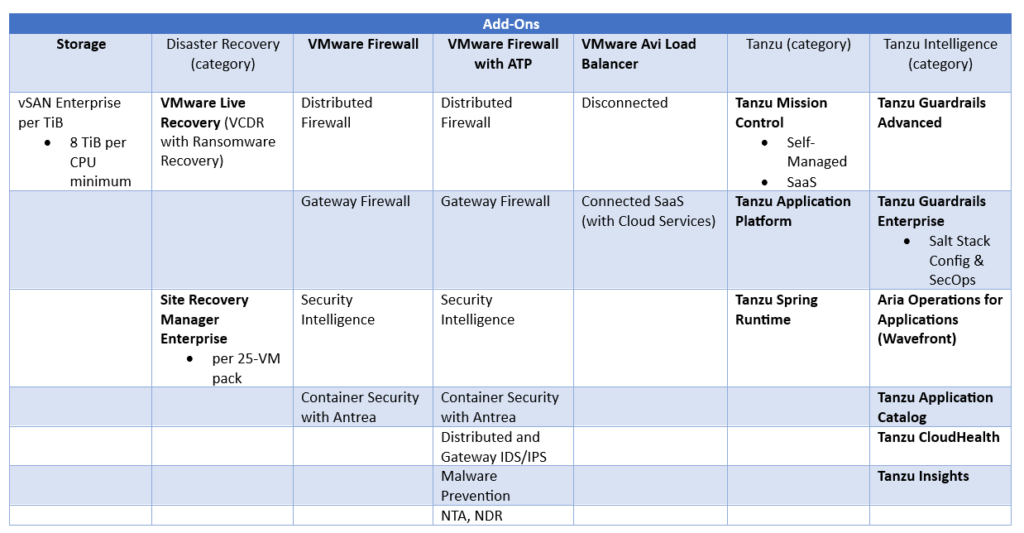
Add-ons for VVF and VCF

The table below gives you an overview of which add-ons are available at the time of writing this blog.

Make sure to contact your VMware representative to understand which add-ons are available for VVF and VCF.

Note: Available add-ons are the text in bold.
VVF and VCF Add-ons

Tanzu Guardrails (formerly VMware Aria Guardrails)

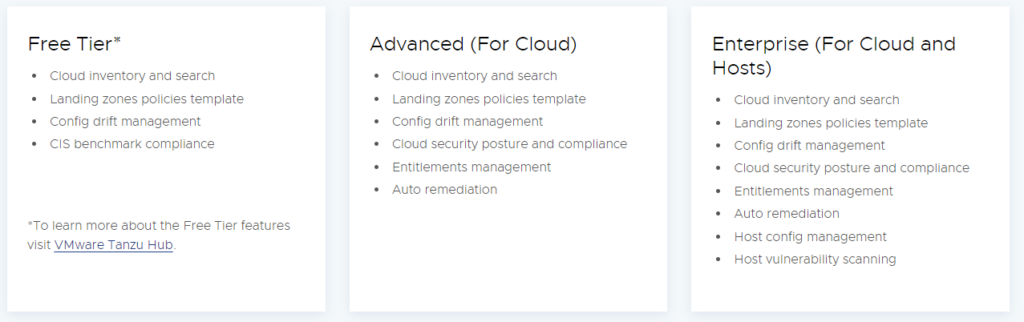
Looking at the official Tanzu Guardrails product website we can learn the following:

Tanzu Guardrails Editions

Note: It seems that Tanzu Hub is part of Tanzu Guardrails Advanced and Enterprise

SRE Services for VMware Cloud Foundation

VMware Site Reliability Engineering (SRE) Services for VMware Cloud Foundation provide VMware expertise to create highly reliable and scalable cloud environments. The services provide a range of capabilities from patching and upgrades to security hardening to automated management and operations.
The SRE Services for VCF datasheet can be found here.

How to count cores for VVF/VCF and TiBs for vSAN add-on?

Please have a look at this updated knowledgebase article: KB95927

What about VMwara Aria SaaS?

Customers have no more option to buy VMware Aria products as standalone products or as SaaS: https://blogs.vmware.com/management/2024/01/dramatic-simplification-of-vmware-aria-as-part-of-vmware-cloud-foundation.html

The Aria cloud management capabilities are available only as components of VMware vSphere Foundation and VMware Cloud Foundation, which are sold for deployment on-premises or on certain public cloud providers including VMware Cloud on AWS. Existing Aria SaaS subscriptions will continue through the end of their term. At time of renewal, customers should purchase VMware vSphere Foundation and VMware Cloud Foundation.

Use this KB96168 to understand which products are impacted by this new policy.

What about Tanzu products?

For some of us, it seems that the Tanzu products are only available as VVF/VCF add-ons, which is not true.

Based on the different comments on various social media platforms and the interviews we have seen from VMware by Broadcom executives, we can say the following:

  • vSphere with Tanzu (aka TKGs) with its Supervisor architecture is going to be the long-term strategy (part of VVF and VCF)
  • Heavy focus on Tanzu Application Platform (TAP) and Tanzu For Kubernetes Operations (TKO)
  • We can expect continued support for TKGm and TKGi

Tanzu Portofolio and Strategy Recap

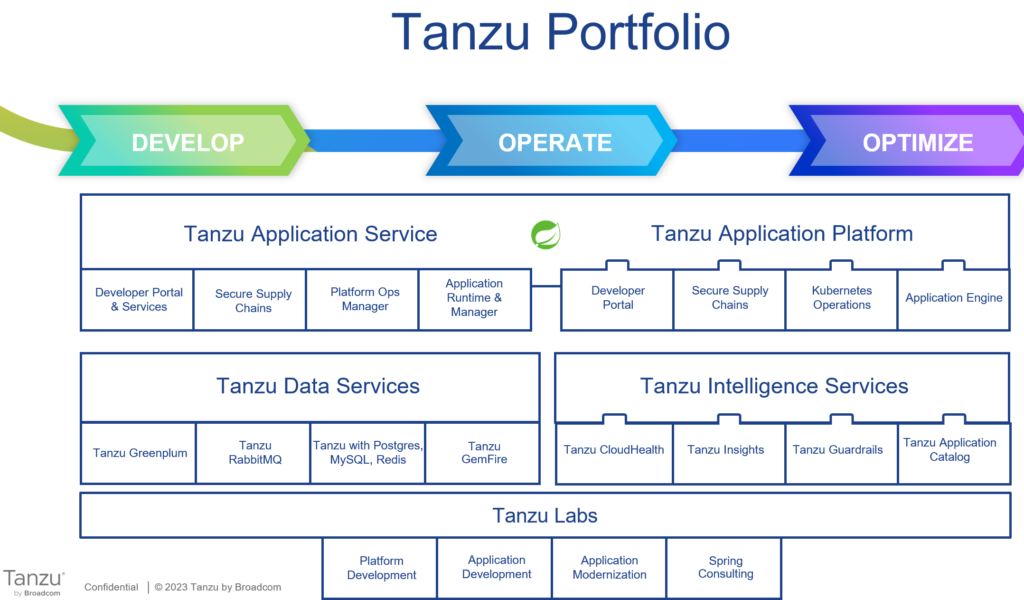
At VMware Explore 2023, VMware presented the “develop, operate, optimize” approach when they talk about platform engineering:

  1. Develop – Secure paths to production
  2. Operate – Deploy, managed and scale applications seamlessly
  3. Optimize – Continuously tune cost, performance and security of applications at runtime

We learned that VMware (by Broadcom) is going to invest in TAP, Spring, TKO and data services. What’s the difference between TAS and TAP again?

  • Tanzu Application Service – Opinionated platform built on Cloud Foundry
  • Tanzu Application Platform – Modular and portable PaaS for any conformant Kubernetes

Tanzu Portfolio Jan 2024

Tanzu for Kubernetes Operations Refresher

TKO comes in two different editions:

  • Tanzu for Kubernetes Operations Foundation (TKO-F)
    • Tanzu Mission Control (includes TMC self-managed)
    • Tanzu Service Mesh
  • Tanzu for Kubernetes Operations (TKO)
    • Tanzu Mission Control (includes TMC self-managed)
    • Tanzu Service Mesh
    • Tanzu Observability (aka Aria Operations for Apps, formerly Wavefront)
    • Antrea (CNI)
    • TKGm
    • Harbor, HA Proxy, Calico, FluentBit, Contour, Prometheus, Grafana
    • Avi Essentials (NSX ALB)

Note: NSX Advanced Load Balancer (aka NSX ALB) is no longer part of TKO since NSX ALB can be purchased as an add-on

Last Comments

While I was waiting to publish this blog, William Lam wrote a more detailed blog about VMware vSphere Foundation and VMware Cloud Foundation as well.

It is still early days and we can expect more updates from VMware by Broadcom soon. 🙂


A New Era: Broadcom’s Streamlined Approach to VMware’s Product Lineup and Licensing

A New Era: Broadcom’s Streamlined Approach to VMware’s Product Lineup and Licensing

Krish Prasad, VMware Cloud Foundation division General Manager, published this blog a few hours ago: https://news.vmware.com/company/vmware-by-broadcom-business-transformation

He announced a massive simplification of the VCF division’s product portfolio, which should help customers get more value for their investment in VMware solutions. To summarize Krish’s announcement:

  • There are going to be two primary standardized offers only from now on: vSphere Foundation and VMware Cloud Foundation (VCF)
  • End of sale of perpetual licenses and Support and Subscription (SnS) renewals
  • Bring-your-own-subscription license (BYOL) option, which provides portability to VMware-validated hybrid clouds running VMware Cloud Foundation

Disclaimer: This blog should provide customers and partners with a summary and some additional information from Krish’s announcement. There is also a chance that some of my understanding is incomplete or wrong. This article reflects my personal opinion and understanding, not Broadcom’s.

I will update the blog over the next few days and weeks.

vSphere Editions

The primary vSphere edition moving forward is called “vSphere Foundation”:

The new VMware vSphere Foundation delivers a more simplified enterprise-grade workload platform for our mid-sized to smaller customers. This solution integrates vSphere with our intelligent operations management to provide the best performance, availability, and efficiency with greater visibility and insights.

In other words, from now on vSphere customers get Aria Operations Advanced (formerly known as vRealize Operations) and Aria Operations for Logs (formerly known as vRealize Log Insight) together with vSphere (which has vCenter and Tanzu Kubernetes Grid included).

vSphere Essentials Plus Kit

Components:

  • vSphere Essentials Plus
  • vCenter Essentials
  • Per 96-core Kit (3 host max. / 6 CPU limit / 192-core limit; a host can have either 1x 64 cores or 2x 32 cores max.)
  • Includes Production Support

vSphere Standard

Components:

  • vSphere Standard
  • vCenter Standard
  • Includes Production Support

vSphere Foundation (VVF)

Components:

  • vSphere Enterprise Plus
  • vCenter Standard
  • Tanzu Kubernetes Grid (TKG)
  • vSAN Enterprise 100 GiB free (see FAQ below)
  • Aria Suite Term Standard
    • Includes Aria Operations Advanced and Aria Operations for Logs
  • Includes Production Support
  • Plus Available Add-ons

Add-on Offerings

VMware vSAN Enterprise (add-on for VCF and vSphere Foundation only)

VMware Cloud Disaster Recovery / Ransomware Recovery  (add-on for VCF and vSphere Foundation only)

Site Recovery Manager Enterprise

VMware Advanced Load Balancer (aka Avi)

VMware Firewall (add-on for VCF only), aka NSX Distributed Firewall

VMware Firewall with Advanced Threat Protection (ATP) (add-on for VCF only)

Tanzu Intelligence (details not clear yet)

Tanzu Mission Control (SaaS and self-managed)

Tanzu Application Platform / Spring Runtime (details not clear yet)

More add-ons coming in future (for example Private AI Foundation)

VMware Cloud Customer Journey

Existing VCF or future vSphere Foundation customers would go for the new VMware Cloud Foundation now, which can now be considered a true full-stack private and hybrid cloud stack:

VMware Cloud Foundation, our flagship enterprise-class hybrid cloud solution for customers to run their business critical and modern applications – in a secure, resilient and cost efficient manner. To allow more customers to benefit from this solution, we’ve reduced the previous subscription list price by half and added higher support service levels including enhanced support for activating the solution and lifecycle management.

Very important in case you missed that from the vSphere Foundation section above: Moving forward, VMware Cloud Foundation only includes NSX for network virtualization (overlay), with no more micro-segmentation or distributed firewalling (DFW) capabilities.

In other words, customers who need NSX’s DFW (VMware Firewall add-on) capabilities, need a VCF subscription first, which includes NSX.

Note: Currently, all new licensing bundles are coming in a “disconnected” fashion (no VMware Cloud connectivity)

While Krish mentioned BYOL and license portability in the future, there seem to be no immediate changes about the VMware Cloud and other hyperscaler offerings.

VMware Cloud Foundation (VCF)

Components:

  • vSphere Enterprise Plus
    • Includes TKG and vCenter Standard
  • vSAN Enterprise per TiB per X amount of cores
  • Aria Suite Enterprise
    • Aria Operations Enterprise (includes Aria Operations for Logs)
    • Aria Automation
  • NSX Networking for VCF
  • HCX Enterprise
  • Aria Operations for Networks Enterprise (formerly known as vRealize Network Insight)
  • SDDC Manager
  • Includes Select Support
    • Includes SRE (customers must deploy SDDC Manager to be entitled to SRE)
  • Add-ons: See above

Note: Going forward, standalone offerings are being EOA-ed (end of availability) – no more VCF components “a la carte”

VMware Cloud on X

We can expect that long-term these VMC or hyperscaler subscription offerings will converge to VCF.

Final Comments

Look, I do not have all the answers and information yet, because it is a lot to unpack. That is all I can share with you right now. Be patient. 🙂

But, this announcement from Broadcom (Krish) was an unexpected surprise since almost everyone was expecting price increases after the acquisition. Instead, Broadcom is cutting the subscription pricing in half!

An update of the above content can be found here: VMware vSphere Foundation and VMware Cloud Foundation Overview

Additional Resources

Unofficial Licensing FAQ

  • Q: What if I am a vSphere Essentials customer?
    • A: I would recommend the vSphere Essentials Plus Kit
  • Q: What if I only need vSphere Enterprise Plus?
    • A: Your best option is vSphere Foundation. There are no more standalone products.
  • Q: Do I need VCF if I want NSX distributed firewall?
    • A: Yes, at the moment this seems to be the case that the “VMware Firewall” (distributed firewall aka micro-segmentation) add-on cannot be subscribed as a vSphere Foundation customer. The same is true of other features like security or gateway firewall.
  • Q: What if have/need vSphere for Desktop?
    • A: The recommended solution is vSphere Foundation
  • Q: What if I am a vCloud Suite customer?
    • A: VMware Cloud Foundation makes sense for vCloud Suite Enterprise and Advanced editions. If you have vCloud Suite Standard I recommend vSphere Foundation going forward.
  • Q: How many vCenters are included?
    • A: To my knowledge, it is one vCenter per core. So, one could say that this means “unlimited”.
  • Q: What happens to the Avi (NSX ALB) Basic edition?
    • A: It seems there will be no Avi Basic anymore. Customers need to go for the add-on.
  • Q: Do customers from now on need to deploy SDDC Manager as part of VMware Cloud Foundation?
    • A: No, they do not. But to be entitled to SRE, you need to deploy the full stack.
  • Q: How is Site Recovery Manager (SRM) Enterprise licensed?
    • A: Per protected 25-VMs
  • Q: What about the True Visibility Suite (TVS)?
    • A: These management packs will be enabled as part of the Aria Suites which are included in vSphere Foundation and VMware Cloud Foundation.
  • Q: What about (vSAN) ROBO licenses?
    • A: ROBO licenses are EOA as well, but all vSphere Foundation customers will receive vSAN Enterprise 100 GiB (for free) for every core purchased.
  • Q: What is included in the Tanzu Intelligence add-on?
    • A: Tanzu Guardrails (Advanced or Enterprise), Aria Operations for Apps (formerly known as Tanzu Observability (aka Wavefront)), Tanzu Application Catalog, Tanzu CloudHealth Enterprise, Tanzu Insights
  • Q: What happened to SaltStack Cionfig and SecOps?
    • A: Both are part of the Tanzu Guardrails Enterprise add-on
  • Q: Can customers mix perpetual and new offerings?
    • A: In general yes.
  • Q: Can you tell me more about the vSAN free tier included with vSphere Foundation?
    • A: It seems you are going to be entitled to a maximum of 100GiB per core in the vSAN storage cluster. Example: 4 hosts with 32 cores each * 100GiB = 12.8TiB (without paying for any vSAN add-on!).
      • Important: This feature will be available in one of the upcoming releases. Hopefully in vSphere 8.0U3 🙂